The First ZK-Rollup with a Decentralized Sequencer Set


Layer 2 Rollups are a core part of Ethereum’s rollup-centric roadmap. Optimistic and zero-knowledge rollups offer higher throughput and lower costs by executing smart contract state changes off-chain and proving them on-chain.
The vision for Rollups to help scale Ethereum has already begun to blossom. Today, the Total Value Locked across all L2 Rollups is around $37.35 B, with Arbitrum One, Base, and Optimism accounting for well over half of that.
It’s clear that Layer 2 Rollups are the solution to help scale Ethereum. Vitalik himself even stated in a recent blog post that the goal would be for Ethereum to hit 100,000 TPS by utilizing rollups.
When thinking about rollups, one aspect that often flies under the radar is the role of sequencers.
In this report, we take a closer look at the role of sequencers, the current state of sequencers in the Ethereum rollup space, and how Starknet is setting a new standard when it comes to decentralizing the sequencer set.
What are Sequencers?
Sequencers are responsible for ordering transactions and are employed by rollups to enhance the user experience with lower fees and quicker transaction confirmations.
In Layer 2 networks, sequencers manage transactions between the L2 and L1 systems. They:
- Retrieve transactions from the L2 mempool, determine which transactions to execute or discard, and broadcast transaction outcomes to other nodes.
- Group transactions into batches, compress them, and periodically submit these batches to the main Layer 1 blockchain, like Ethereum, for final verification.
- Ensure transaction order, which can be based on the time of submission (first-come, first-served) or prioritize transactions with higher gas fees.
- Act as traffic controllers, organizing transaction flow in the L2 to maintain efficient and secure interactions with the underlying L1 chain.
This batching process is essential as it helps reduce transaction costs and increases efficiency for the L2 network, while the sequencer earns a portion of the transaction fees as compensation.
In zkEVM networks, a sequencer node selects and batches transactions, submitting them to the smart contract on Ethereum. To enable decentralized applications to access this data, a synchronizer reads events from the Ethereum contract, storing ZK validity proofs from the aggregator and transaction batches from the sequencer.
The Current Landscape of Rollups
The table below shows the top 10 Layer 2 Rollup solutions, sorted by TVL.
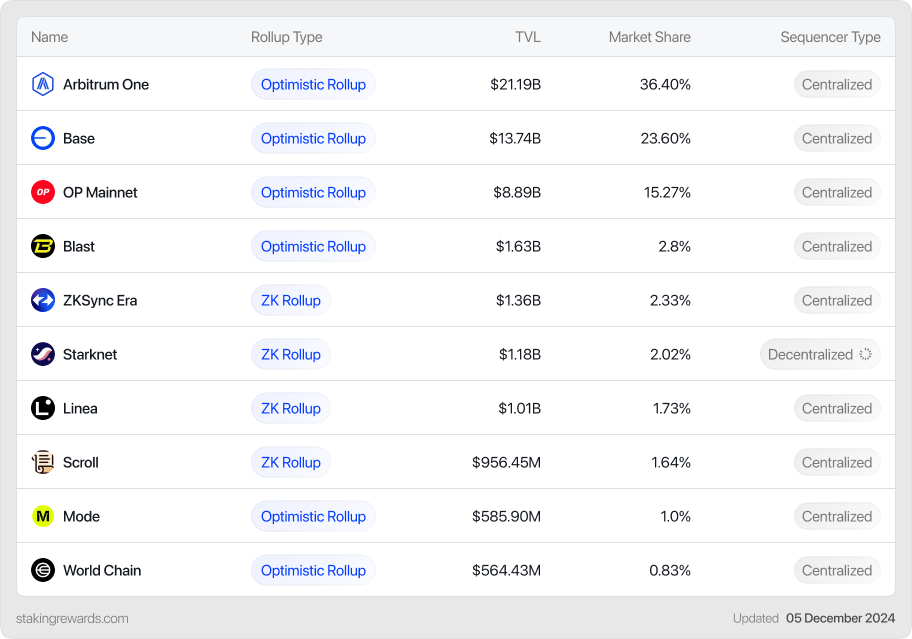
Data from l2beat.com, updated 05 Dec 2024
The Risk of Centralized Sequencers
Almost all of the major L2s have opted to run their own centralized sequencers, operated by their core dev teams. This comes as no surprise since doing so provides more convenience, cost-efficiency, and user-friendliness.
While the centralized sequencer approach works, it raises critical concerns, which include:
- A Single Point of Failure: If the centralized sequencer experiences downtime or technical issues, the entire rollup can go offline, halting transaction processing and data submission to the main Ethereum network. This vulnerability was highlighted during the Arbitrum L2 downtime, which lasted 78 minutes.
- Transaction Censorship: A centralized sequencer can arbitrarily choose to exclude or blacklist certain transactions, impacting user access and fairness in the network.
- Improper MEV Extraction: With complete control over transaction ordering, the sequencer can engage in Maximum Extractable Value (MEV) practices, such as frontrunning transactions, to profit at the expense of users.
- Centralization Risk: Relying on a single sequencer introduces centralization concerns, undermining the decentralized ethos of blockchain technology and increasing security vulnerabilities.
- Revenue Concentration: All transaction fees and rewards from the network are accumulated by the sole sequencer, creating a lack of revenue distribution and limiting incentives for broader network participation.
These risks highlight the trade-offs in L2 rollup designs and underscore the importance of developing decentralized sequencer solutions to enhance security, fairness, and resilience in the ecosystem.
While some rollups offer mechanisms to bypass the sequencer and submit transactions directly to Ethereum for censorship resistance, these features can be inactive as systems mature. This centralized model dominates the current rollup landscape, emphasizing a trade-off between scalability and decentralization and driving the need for decentralized sequencer models. Centralized sequencers have unique access to all incoming transaction data, allowing them to leverage this advantage for MEV.
The First ZK-Rollup with a Decentralized Sequencer Set
Starknet isn't just another L2. It is the first ZK-Rollup to implement a staking mechanism. This move aligns with Starknet's mission to enhance scalability without compromising on decentralization or security.
As part of that vision, Starknet is transitioning from a single, centralized sequencer model to a decentralized architecture. By doing so, sequencers will act as individual entities responsible for:
- Transaction Management: Collecting, ordering, and executing transactions.
- Batching: Bundling transactions into efficient batches.
- Block Production: Producing blocks that are then proved by provers and submitted to Layer 1.
This setup enables Starknet to achieve higher transaction throughput while leveraging Ethereum for security via validity proofs. Currently, Starknet relies on a single sequencer managed by StarkWare. However, decentralization of this role will be a key milestone in Starknet’s roadmap. Decentralized sequencers aim to:
- Increase Robustness: By enabling multiple participants to act as sequencers, the network becomes more resilient and less reliant on a central entity.
- Introduce Leader Election: A consensus mechanism will govern the selection of sequencers, ensuring fairness and accountability.
- Reduce Trust Assumptions: Users and nodes will no longer need to trust a single sequencer but instead rely on a distributed network of sequencers operating under a shared consensus protocol.
The future of Starknet includes plans to implement a consensus mechanism that will facilitate leader election among sequencers.
- Consensus Implementation: Starknet plans to introduce a consensus mechanism that allows decentralized leader election among sequencers.
- Stake-based Sequencing: Sequencers will likely stake tokens as collateral, incentivizing honest behavior and penalizing malicious activities.
- Frequent Proof Generation: Decentralized sequencers will work in tandem with provers to generate and submit proofs more frequently, reducing latency in state updates.
The partnership between Starknet and Informal Systems focuses on decentralizing Starknet's sequencer to enhance fault tolerance and censorship-resistance. Using expertise in the Tendermint consensus algorithm, Informal Systems is developing Malachite, a Rust-based, high-performance sequencer core designed for efficiency and scalability. The key initiatives include:
Tendermint Consensus Adaptation
- The collaboration started with technical discussions around adapting the Tendermint consensus algorithm for Starknet's ZK-based Layer 2.
- The Tendermint algorithm, offering Byzantine Fault Tolerance (BFT), was identified as a core protocol for achieving fault-tolerant decentralized sequencing.
Malachite Implementation
- Informal Systems is building Malachite, a Rust-based, modular, and high-performance sequencer core designed for specialized use cases.
- Malachite is focused on efficiency, extensibility, and rigorous testing to address edge-case complexities common in distributed protocols.
- Malachite complements existing consensus engines like CometBFT, aiming to serve as a lean and adaptable alternative for Starknet's needs.
The sequencer will be decentralized with multiple implementations to ensure diversity and resilience. It will also feature dynamic node reconfiguration to counter censorship or failures, guided by Layer 1 (Ethereum) rules. This collaboration strengthens Starknet’s scalability and security while laying the foundation for greater interoperability across ecosystems.
The Roadmap for Staking on Starknet
STRK staking launched on mainnet on Nov 26, marking a key step toward full decentralization. Starknet’s roadmap includes:
- STRK Token Launch and Governance Voting on Mainnet.
- Phase 1: Staking protocol with stake delegation tested successfully for weeks with over a thousand participants, moving to mainnet on Nov 26, 2024, with validators running full nodes.
- Future phases to deepen decentralization and security.
Staking Features:
- Validators: Stake 20,000+ STRK with an option to enable delegation.
- Delegation: Users can delegate STRK without operating nodes.
- Lock-Up Period: Unstaking requires 21 days without earning rewards.
This transition enhances decentralization, and network security, and unlocks new use cases like liquid staking tokens.
Interested in staking STRK, head over to the Staking Rewards Stake App and start earning yield on your tokens.

More from Research

Institutional-Grade Research
Delivered to Your Inbox
Join 12,000 institutional allocators worldwide. No spam, unsubscribe anytime.