Monad Explained: Everything You Need to Know About the High Performance Layer 1
What is Monad? A High Performance Layer 1 Blockchain
At its core, Monad is a new layer 1 blockchain built for speed without compromise. Unlike projects that create entirely new ecosystems, Monad is fully compatible with the Ethereum Virtual Machine. This means any Ethereum application can run on Monad without changes. Developers can continue using Solidity to write smart contracts, users can keep their existing wallets, and the transition feels seamless.
What sets Monad apart is not just its compatibility but also its performance. The network is designed to handle more than 10 000 transactions per second, with block times of just four tenths of a second and finality in under 1 second. This is not a small improvement over Ethereum’s current throughput. It is an entirely new experience. Imagine interacting with a decentralised exchange and seeing your transaction confirmed almost instantly, or sending a payment that arrives in less time than it takes to refresh a webpage.
How is this possible? Because of a combination of carefully engineered innovations:
Optimistic Parallel Execution
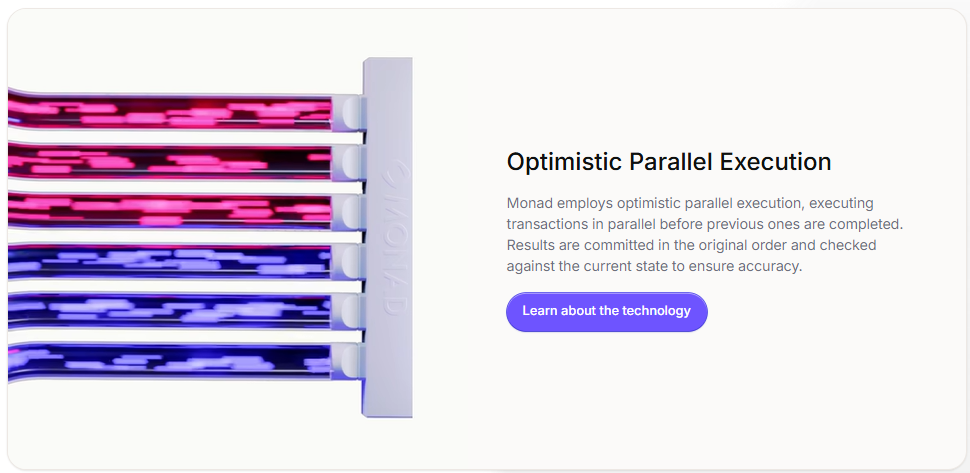
Traditional blockchains process transactions like people crossing a bridge one at a time. It is safe but slow. Monad is like building multiple lanes on that bridge, allowing many people to cross at once. At the end, everything is checked to make sure everyone arrived in the right order. This makes the system far faster while still keeping it accurate.
Asynchronous Execution
Most blockchains follow a rigid sequence: agree on a block, execute the transactions, and then repeat. Monad separates these tasks into a pipeline, so consensus can be finalised on one block while execution is already underway on another. This is like an assembly line where each step is handled in parallel, keeping the system running at full capacity.
MonadBFT
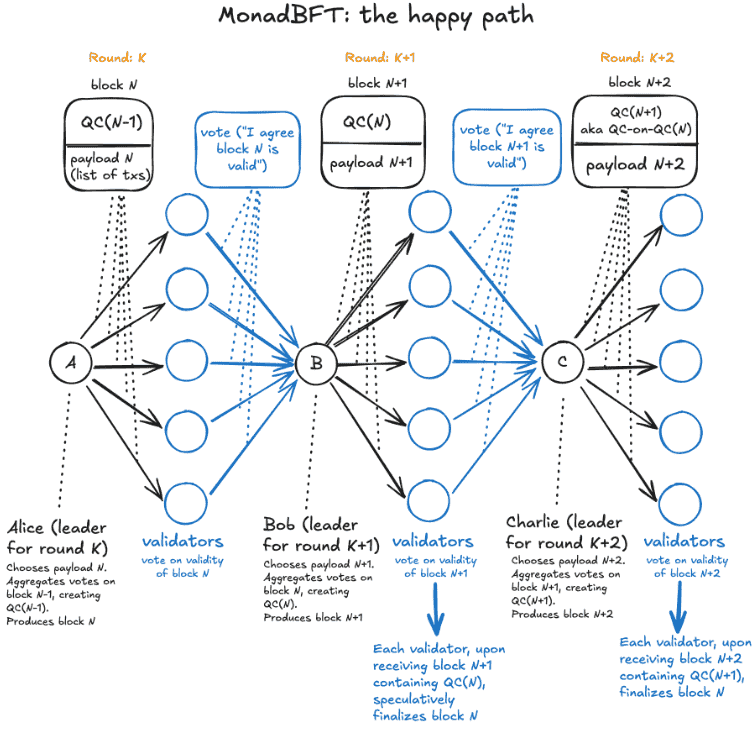
Consensus is the process that allows nodes to agree on the state of the blockchain. Monad uses its own streamlined version of the HotStuff protocol, called MonadBFT. By reducing the number of communication rounds needed, MonadBFT shortens the time it takes for nodes to agree, much like cutting a three step approval process down to two without reducing security.
MonadDB
Ethereum’s underlying database structure can slow things down, particularly when accessing state data. Monad has built MonadDB, a custom database optimised for solid state drives. This ensures validators can run efficiently on consumer grade hardware rather than requiring specialised machines.
RaptorCast
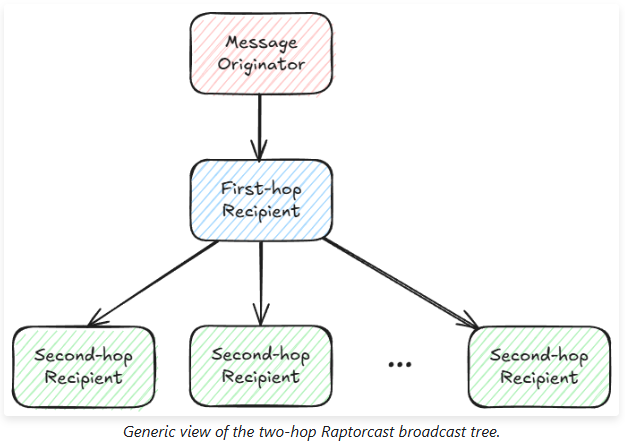
When a new block is created it needs to be shared with the entire network. RaptorCast is Monad’s broadcast protocol, designed to spread blocks quickly and efficiently so all participants are aligned in near real time.
Each of these improvements is powerful on its own, but together they deliver the kind of responsiveness that makes Monad feel instant. It is important to notice that this is achieved without abandoning decentralisation. Validators can run on accessible hardware, which means participation remains open to a wide community and is not limited to those with deep pockets.
If you want to dive deeper into Monad’s technical design, take a look at our detailed explainer: What is Monad? A High Performance Layer 1 for the Future of Crypto.
Why All the Hype? Momentum Around Monad
The excitement around Monad is not based on promises alone. Its testnet has already processed billions of transactions, providing a glimpse of the network’s potential in real-world conditions.
A growing ecosystem of projects is preparing to launch when mainnet goes live. Among them:
- Drake is building a decentralised exchange for perpetual contracts, combining the liquidity of order books with the efficiency of automated market makers.
- Dirol Protocol aims to become a DeFi hub with lending, borrowing, and trading services powered by Monad’s throughput.
- FWX introduces permissionless leverage trading where users can create their own lending pools, functionality that would be prohibitively expensive on Ethereum.
- Dynamic provides wallet and authentication infrastructure with smart wallet SDKs, lowering barriers for developers.
- EOracle focuses on decentralised price feeds, essential for accurate DeFi applications.
- Fizen.io is developing a crypto super app that integrates payments and wallets for everyday use cases.
- Farcaster explores Monad as a base for decentralised social networking, a sector where high throughput and low fees are critical.
- Entangle builds cross chain infrastructure and oracle services, ensuring Monad is not isolated but interconnected.
- Portal, acquired by the Monad Foundation, provides stablecoin and payment infrastructure, underlining Monad’s focus on real-world financial applications.
Beyond projects, Monad has been actively fostering its community. The Monad Madness competition set aside $1 000 000 in prizes and provided exposure to venture capital firms with up to $60 000 000 in potential investment. Earlier hackathons offered over $100 000 in prizes and milestone-based grants. Together, these initiatives show that Monad Labs and the Foundation are not just building technology, but also cultivating an ecosystem around it.
The MON Token: What We Know
Like most layer 1 blockchains, Monad has its own native token called MON. On the testnet, MON is used for gas fees and can be claimed through the official faucet. This allows developers and users to experiment with transactions, deploy contracts, and interact with applications in a risk-free environment.
What remains undisclosed is how MON will function once mainnet is live. There are no official details yet about total supply, distribution, or staking rewards. It is expected that MON will continue to serve as the token for gas and likely as the staking asset for validators, but until launch this remains unconfirmed.
For now the picture is simple. MON exists on testnet, it powers transactions, and it offers a taste of what the live network will feel like.
Staking on Monad with Simply Staking
Staking is at the heart of any proof of stake blockchain. It involves locking up tokens to help secure the network. In return, stakers can earn rewards. This process not only incentivises participation but also keeps the blockchain decentralised by encouraging many different validators to take part.
When mainnet launches, MON holders will be able to stake their tokens to support the network. Simply Staking will provide professional validator services, allowing token holders to participate with confidence. With a strong track record of securing networks across the industry, Simply Staking ensures that staking MON will be both safe and reliable.
This role is vital because Monad has been designed to run on consumer grade hardware. That design philosophy only works if validators are widely distributed. By offering dependable staking services, Simply Staking helps uphold Monad’s commitment to decentralisation while giving users an accessible way to take part.
Spectrum RPC Support: Reliable Infrastructure for Builders and Users
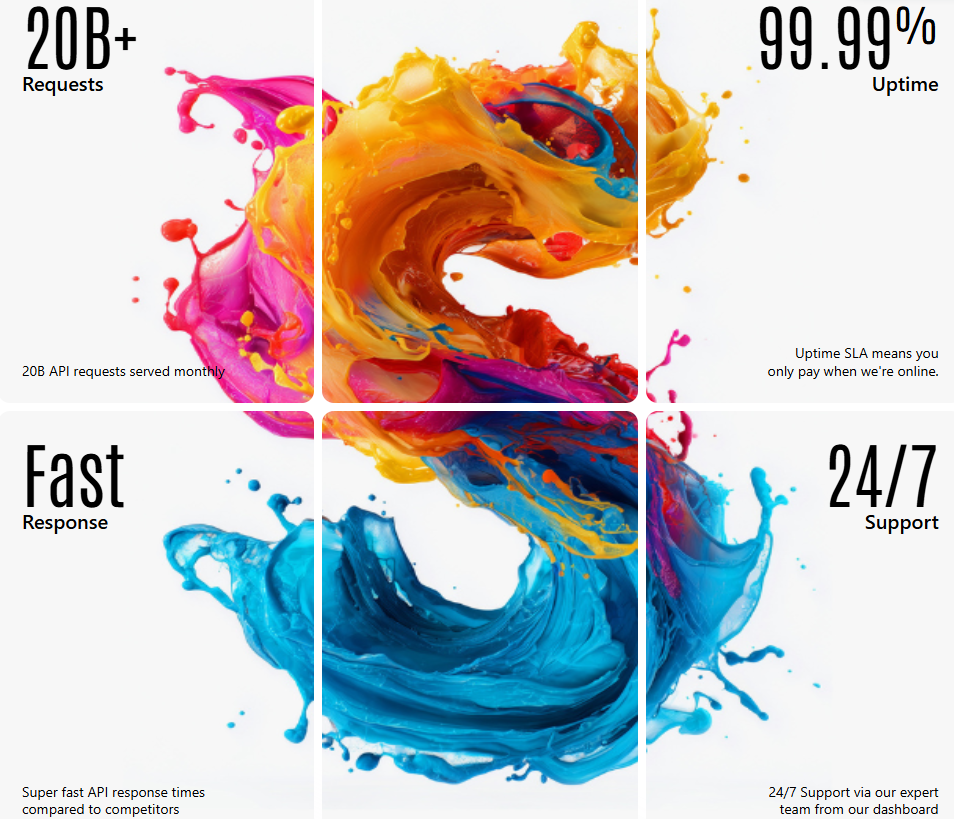
Transactions and applications do not interact with a blockchain directly. They rely on RPCs, which act as the gateway between wallets, applications, and the underlying network. Without reliable RPC services, even the fastest blockchain can feel unresponsive.
Spectrum, Simply Staking’s RPC platform, provides that reliability. It delivers high performance access points that developers can trust for building and scaling their applications. Users also benefit because strong RPC infrastructure ensures their transactions and interactions run smoothly.
Monad will be supported on Spectrum from the beginning. This means developers building on Monad can immediately plug into infrastructure designed for speed, scalability, and resilience.
To discover more about how Spectrum supports networks like Monad, visit Spectrum RPCs.
Why Monad Matters for the Future of Crypto
Monad is more than a technical achievement. It represents a vision for how blockchains can scale without sacrificing compatibility or decentralisation. For developers, it means building familiar applications that finally feel fast enough for mainstream adoption. For users, it means transactions that confirm instantly and fees so low they fade into the background. For the ecosystem, it means a foundation where decentralised finance, payments, and even social networks can thrive.
By supporting Monad through staking services and RPC infrastructure, Simply Staking is helping to turn this vision into reality. As mainnet approaches, Monad is not just another blockchain project but one of the most promising new players in the space.
Conclusion: The Road Ahead
Monad has quickly become one of the most anticipated layer 1 blockchains in crypto. Its combination of Ethereum compatibility, innovative architecture, and growing ecosystem sets it apart from the crowd.
Simply Staking is proud to support this journey. Whether through secure staking services for MON or reliable RPC infrastructure with Spectrum, our goal is to help the Monad community grow and succeed!

More from Featured
Institutional-Grade Research
Delivered to Your Inbox
Join 12,000 institutional allocators worldwide. No spam, unsubscribe anytime.