LBTC: A New Era of DeFi Powered by Lombard’s Liquid Staked Bitcoin


TL;DR;
- Bitcoin liquid staking is emerging as a major opportunity to deploy BTC in DeFi, driven by protocols like Lombard, built on Babylon.
- Lombard's liquid staking token (LBTC) allows BTC holders to earn yield in DeFi while keeping their BTC liquid, cross-chain, and secure.
- Lombard has seen strong growth, with $250M in BTC deposits since launch.
- LBTC's integration with multiple DeFi platforms (Uniswap, Gearbox, Pendle, etc.) highlights its potential to transform BTC into a yield-generating asset in DeFi.
BTC as an asset class is over 3 x the size of ETH in terms of Market Cap.
Yet unlike its counterpart, nearly all of the BTC in existence is seen as a store of value, locked away in cold storage, remaining idle in a user's wallet. Could this be about to change?
The opportunity for Bitcoin capital to be deployed in DeFi is huge. With the advent of Bitcoin staking, made possible by Babylon, a number of new liquid staking protocols have emerged, using staked BTC as an underlying form of collateral.
To further paint the picture on the opportunity, if only 5% of BTC made its way into DeFi (around $50B at current market prices), it would still be more than the total value locked (TVL) in the entire Ethereum DeFi ecosystem.
In this article we’ll explore Lombard, a new liquid staking protocol that is leading the charge when it comes to connecting BTC with the world of DeFi.
Read the full guide on how to stake Bitcoin with Lombard and mint LBTC.
What is Lombard?
Lombard is a liquid staking protocol built on top of the Babylon protocol. Lombard’s flagship product is LBTC, a liquid staking token that represents a user’s staked BTC with Babylon. With LBTC, a user can participate in DeFi (similar to Lido’s stETH on Ethereum), whilst retaining the core attributes of Bitcoin, such as its value and security.
LBTC differentiates itself from other liquid staked BTC tokens by being natively cross-chain, meaning LBTC has potential for broader adoption across the entire DeFi ecosystem.
In July 2024, Lombard closed a $16 million seed funding round led by Polychain Capital, with participation from BabylonChain, Inc., dao5, Franklin Templeton, Foresight Ventures, HTX Ventures, Mirana Ventures, Mantle EcoFund, Nomad Capital, OKX Ventures, and Robot Ventures.
Lombard has already made significant headway in the market with LBTC. Since launching on Ethereum mainnet on 21st August, it has secured 4,601 in BTC deposits, worth $254m at the current market price.
Native BTC staking on Babylon vs. Liquid Staking on Lombard (LBTC)
See below table, which outlines the differences between native staking on Babylon and liquid staking via Lombard (LBTC).
| Native Staking (Babylon) | Lombard (LBTC) | |
| Fees | None | 10% fee on Babylon staking yield |
| Liquidity | None | Fully liquid via LBTC |
| Caps | Full - Unclear when lifted | Unlimited |
| Risk | Self-Custodial Vault | Multi-Sig for Custody (Trust in Lombard Consortium) |
| Complexity | Medium (Limited Ledger Support so far) | Easy (Full Ledger Support) |
| Rewards | BTC staking rewards + Babylon points | Babylon staking rewards + Babylon points + Lux + DeFi yield and incentives from destination protocols |
| Target User | BTC holders looking to participate in Babylon BTC Staking | BTC holders looking to participate in Babylon BTC Staking, whilst keeping their position liquid |
| Capital requirements | 0.05 BTC in a hot wallet | Min of 0.0002 BTC in a hot or cold wallet. No limit on cap. |
LBTC vs Other Bitcoin Liquid Staking Tokens
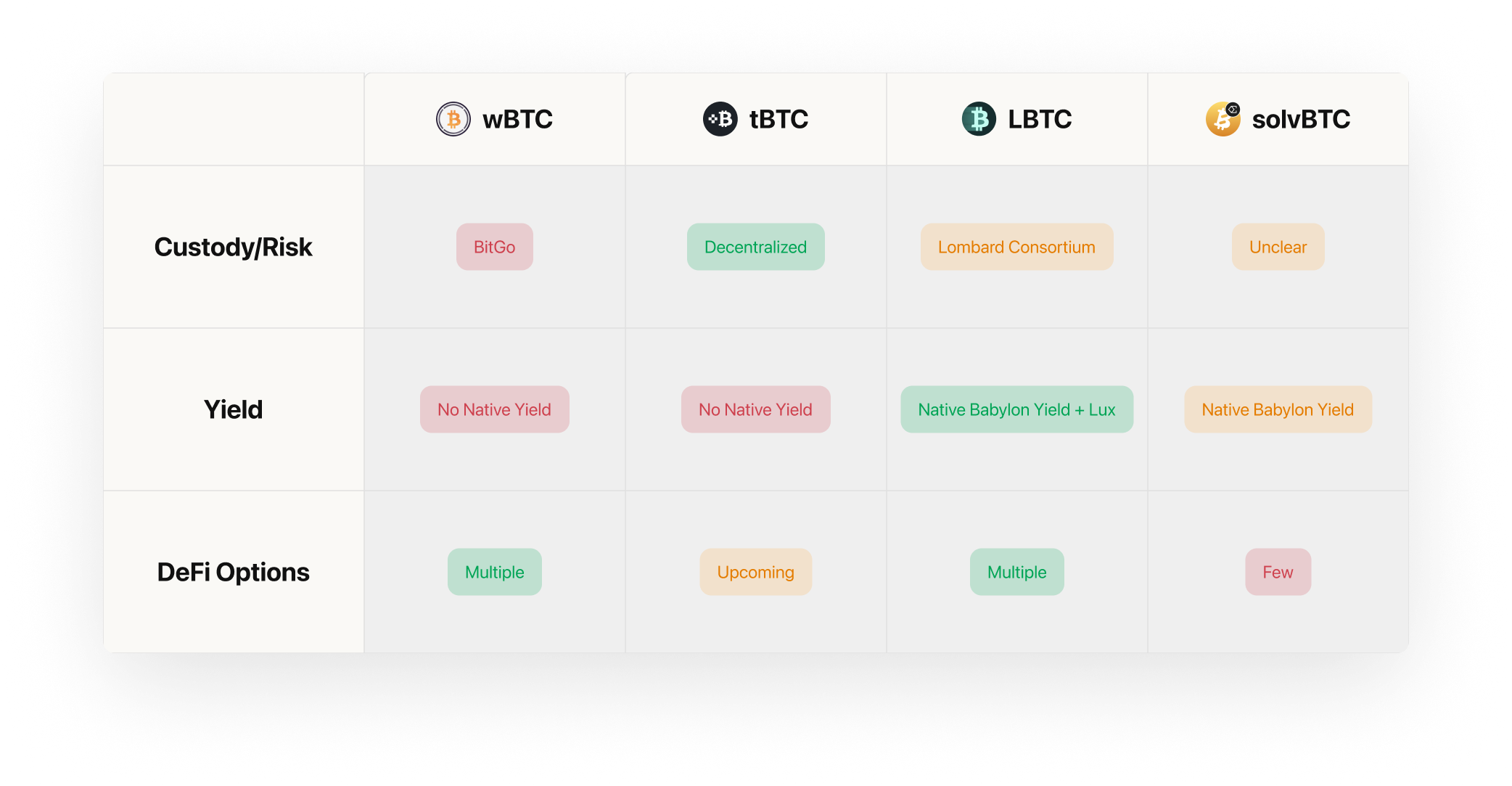
Alongside LBTC there are a range of other popular tokens that enable Bitcoin to be used as a liquid asset. Here's how LBTC stacks up against other major tokens like wBTC, tBTC, and solvBTC.
A Look at Lombard (LBTC) Under the Hood
Fundamentally, Lombard is an Ethereum protocol that enables natively staked Bitcoin (via Babylon) to be used in DeFi.
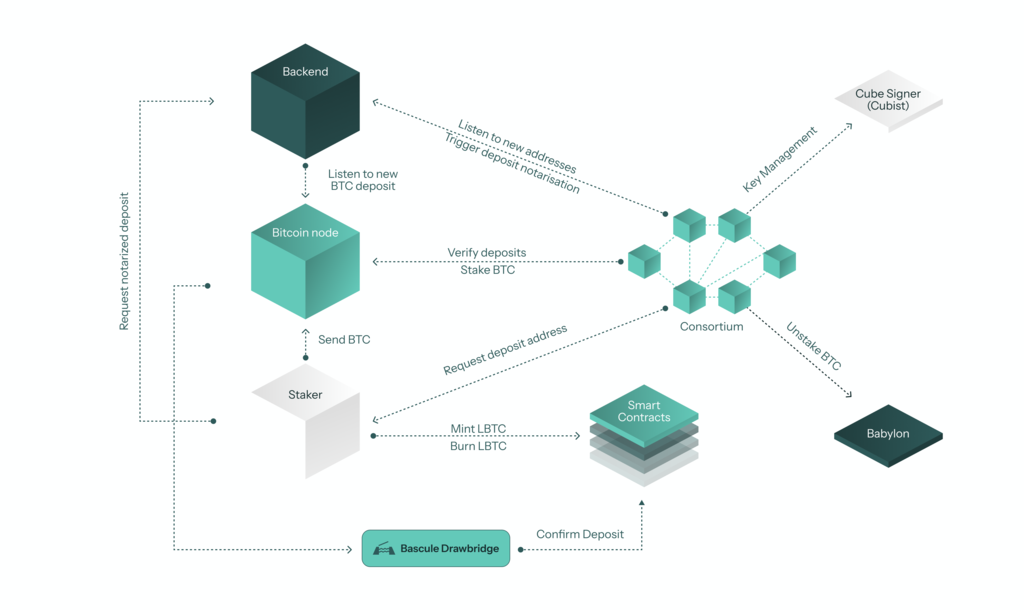
The process of minting LBTC begins with a user depositing BTC to a unique Bitcoin address generated by Lombard, this is then secured and notarized by the Lombard Security Consortium. Once notarized, the BTC is held to be natively staked with Babylon and the user can immediately mint LBTC on Ethereum (or other supported chains).
For a full guide on how to stake BTC and mint LBTC follow the steps in our Lombard BTC staking tutorial.
To enable the creation of LBTC, Lombard utilizes a multi-layered approach to securing protocol operations.
Decentralized Validation Powered by Lombard’s “Security Consortium”
Lombard takes a unique approach to eliminate any single points of failure on a protocol level. Lombard achieves this via its own “Security Consortium”, a group of independent parties that validate key protocol operations. Security Consortium members run a decentralized network of nodes to manage processes, such as creating BTC addresses, verifying deposits, and facilitating the staking and unstaking of BTC.
Fortified Key Management & Bridging
Lombard adds another layer of security in its operations by using hardware-enforced key management and a cross-chain “drawbridge”.
For key management, Lombard utilizes Hardware-Backed MPA Wallets from CubeSigner. This enables multiple security measures, like timelocks and multi-party approvals (MPA), to ensure that transactions require multiple signatures, preventing unauthorized access.
Lombard also utilizes a Bascule Drawbridge, an Ethereum-based state oracle, to add another layer of security by attesting the truth from the Bitcoin network. The backend ensures smooth transaction processing, tracking stake addresses, verifying transactions, and enabling the minting of LBTC.
For a full rundown on Lombard’s protocol architecture, head to their docs.
Outlining the Opportunities for LBTC in DeFi
BTC native staking with Babylon is poised for huge growth in the coming months. With Lombard’s LBTC, stakers are presented with a whole new world of opportunities to earn additional yield via their Liquid Staked BTC.
The future looks bright for LBTC, with many planned integrations across DeFi to go live in the coming weeks and months.
DeFi opportunities that are already live include:
Lombard vault (powered by Veda)

The Lombard DeFi Vault is an automated yield management solution that allows users to deposit LBTC or WBTC to earn optimized BTC-denominated returns. Developed with Veda, the vault strategically deploys deposits across various DeFi products, including providing liquidity on DEX platforms, lending on protocols like Gearbox and Morpho, and yield trading on Pendle. The vault automatically compounds DeFi rewards, converting them into LBTC for maximized returns, all while simplifying the process for users.
Uniswap / Curve
Users can use LBTC to provide liquidity into pools on Uniswap and Curve. Each of which support LBTC/WBTC delegations. Adding liquidity earns providers fees from trading activities performed by DEX users. Supplying LBTC in a WBTC pair mitigates the common LP issue of impermanent loss.
Although recently launched, Uniswap and Curve liquidity pools TVL have already grown to $14M and $1.5M respectively, signally early interest for BTC in DeFi.
Ether.fi & Symbiotic
Both Ether.fi and symbiotic enable liquid restaking for LBTC. By depositing LBTC, users can earn rewards from multiple streams, including native staking yield, restaking APR, and points.
Currently, none of the lsited income sources are live yet. In the meantime, participants will receive points and benefit from multipliers only. Nonetheless, the opportunities presented by restaking have gained significant capital. Ether.fi staking pool for LBTC has a TVL of $48M at the time of writing, while Symbiotic filled its cap of 165 BTC minutes after launching.
Morpho
Two new LBTC markets, curated by Gauntlet and Re7, will launch on Morpho, offering BTC-denominated yields to WBTC suppliers via over-collateralized lending in a secure, permissionless environment. Users can also leverage their LBTC exposure.
Gearbox
LBTC will be added to Gearbox’s ‘Leveraged Points’ product, enabling users to boost LBTC yields through automated looping strategies.
Upcoming opportunities set to go live soon include:
Corn (live on 11 Sep)
LBTC will be integrated into Corn, an Ethereum Layer 2 using BTC as gas. It starts with LBTC deposits into Corn Silos, eventually bridging LBTC to activate DeFi protocols on Corn.
Pendle (live on 11 Sep)
LBTC deposits on Corn will be tokenized on Pendle, providing fixed yields and leveraged positions to increase exposure to rewards like Lombard Lux, Corn Kernels, and PoS staking yields.
Derive (live on 16 Sep)
LBTC will be integrated into Derive, offering complex derivatives strategies, including a covered call spread vault for BTC-denominated yield.
The Road Ahead for LBTC
Lombard’s LBTC is carving out a transformative space in DeFi by unlocking Bitcoin's potential as a yield-generating asset. For the first time, Bitcoin holders can deploy their BTC in a fully liquid, cross-chain environment while preserving Bitcoin's core attributes like security and value. The adoption metrics, including substantial BTC deposits and TVL growth across major DeFi platforms, underscore the growing demand for Bitcoin-based DeFi products.
With upcoming integrations like Corn, Pendle and Derive, Lombard is positioned to further expand the possibilities for LBTC holders, creating a future where Bitcoin becomes a foundational pillar in the broader DeFi ecosystem. As Lombard continues to build and innovate, it’s clear that LBTC could play a pivotal role in shaping the next generation of decentralized finance powered by Babylon staked Bitcoin.

More from Research




Institutional-Grade Research
Delivered to Your Inbox
Join 12,000 institutional allocators worldwide. No spam, unsubscribe anytime.