Lava Network: Scaling RPC Infrastructure into a multi-chain Future


TL;DR;
- Lava Network offers a decentralized, modular RPC infrastructure, addressing the scalability challenges faced by emerging blockchains and rollups.
- Lava provides a unified access layer for easy interaction with multiple blockchains, enhancing the experience for both developers and users by ensuring data accuracy and reliability.
- Users can stake LAVA tokens to validators and then restake the same tokens with RPC providers to maximize their rewards.
- Lava's architecture is designed to support a wide range of ecosystems, including new and emerging blockchains, making it a key player in the multi-chain future of decentralized apps.
The Ethereum landscape is oversaturated with new infrastructure projects.
Until now, there have been few infra projects that address the scalability of Remote Procedure Calls (RPCs), the lifeblood of the entire crypto industry. Popular chains are overdependent on a small handful of good providers, while in general.newer chains are underrepresented by providers.
This article takes a look at Lava Network, their potential impact on the RPC market and how they may help usher in a multichain future with 1000s of new rollups and dApp chains.
What is an RPC?
If you trust in the power of blockchains, you rely on RPCs. However, blockchains are useless unless you can interact with them (read and write).
RPC is a communication protocol that enables users to communicate with a blockchain. Everytime you check your balance in a wallet, make a transaction, or stake tokens, RPC requests are used to relay and update the required data via a blockchain. This communication is dependent on RPC providers, the entities that run RPC nodes help facilitate the exchange of data between a user, the app and a blockchain. Developers also rely heavily on RPC to build, test, and deploy decentralized applications, as it allows them to interact with the blockchain during development and ensure their applications function correctly.
The RPC Provider Ecosystem
The current RPC landscape includes a mixture of both centralized and decentralized RPC providers.
Centralized RPC providers, such as Infura, Alchemy, and QuickNode, dominate the market. These providers handle a significant portion of blockchain traffic, particularly for Ethereum and other major chains.
Decentralized RPC providers, such as POKT Network or dPRC, address the centralization issue by distributing infrastructure across a network of RPC nodes. These providers use token-based incentives to ensure node operators are rewarded for their services.
Lava Network is also a decentralized RPC provider, but we will see how its unique, permissionless approach makes it perfect for supporting a multi-chain landscape.
The Problem Faced by New Rollups and Blockchains
The top RPC providers all deliver decent and reliable service to hundreds of chains. However, there is a dark cloud looming on the horizon. As we move towards a more modular future, what does the future hold for the scalability and decentralization of new rollups?
In general, the current RPC providers do a good job of scaling the number of requests per second needed to power today’s blockchain landscape. The biggest chains, such as Ethereum, already have ultra-solid support but are overly dependent on a handful of providers. Meanwhile, many newer chains are still underserved. RPC providers are already struggling to support the onslaught of new chains. What is the outlook as we move towards a more multi-chain future?
The blockchain space is becoming increasingly more modular, with thousands of dApp chains and rollups expected to launch in the coming years. This presents a very real challenge for the rollups and blockchains themselves. They rely on RPC providers to ensure seamless communication and data relay. However, no RPC provider is going to want to spin out thousands of different RPC nodes, each with a unique set of operational requirements. This will ultimately lead to bottlenecks and a huge drop in efficiency for end users, directly impacting the scalability and performance of rollups and blockchains. Without a robust and scalable RPC infrastructure, the vision of a highly modular, multi-chain future could face significant obstacles.
Lava Network: A Solution to RPC Scalability
Lava Network is a permissionless marketplace for RPC services, purpose built for modular flexibility in a multi-chain era.
Dubbed “the Uber of RPC services”, Lava aggregates RPC providers and connects developers with the most suited providers to match their requirements. This eliminates the need for developers to maintain their own nodes or work with multiple providers. It also creates an open marketplace for any RPC provider to offer services that are in demand - including support for newly launched rollups.
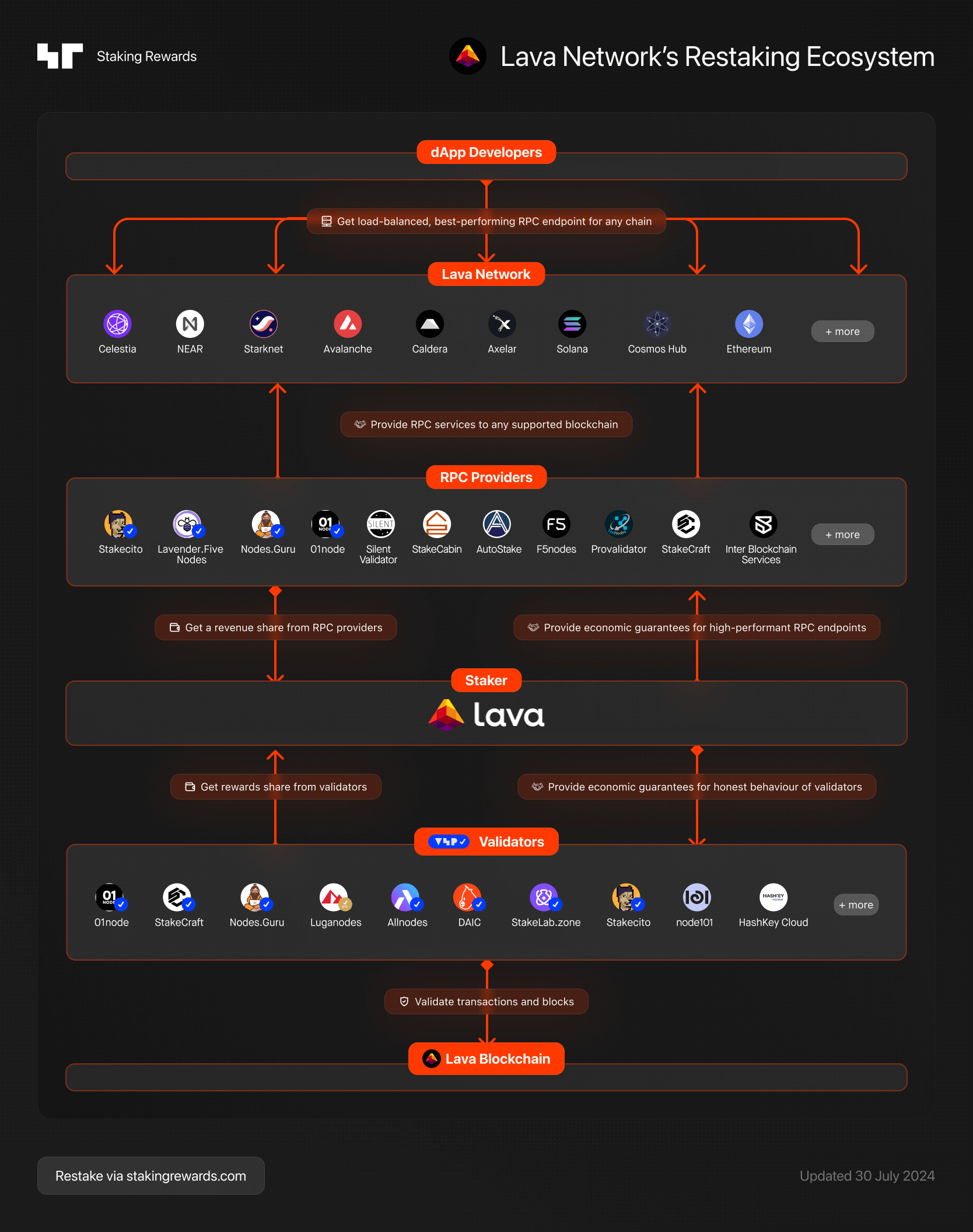
Lava's model ensures that even new rollups are reliably accessible to users and developers. If there's demand for a rollup, Lava can help bootstrap and coordinate a network of RPC providers.
To guarantee a high service quality and decentralization, RPC relays are automatically directed to the most suitable providers, considering factors such as geolocation, response speed, availability, data accuracy, and stake.
All pairings to RPC providers are completely P2P through Lava Network and different strategies can be set programmatically e.g. “optimize my pairings for low latency/accuracy/privacy”.
One of the key features that sets Lava apart is its free RPC service. Unlike other RPC providers, Lava Network does not require payment from users; instead, funds (tokens) are committed to an Incentivized Pool by each blockchain and used to reward the RPC providers, thus bootstrapping the network.
Incentivized Public RPC Pools are funded by participating blockchains and sponsors, containing LAVA and IBC-wrapped tokens. These pools offer extra rewards to providers who meet the ipRPC specifications and standard network rewards. Users enjoy free RPC services, with costs covered by elected consumers through special subscriptions. These consumers, such as DAOs or key ecosystem contributors, finance the pools and set the reward parameters.
How Does Lava Network Work?
With Lava Network anyone can propose specifications for RPC services and provide those services.
Lava Network operates through a decentralized system where providers stake LAVA tokens to join and offer services. Using a peer-to-peer communication model and minimizing the need for its blockchain, it ensures no single point of failure. Consumers (dapps, wallets) fetch a list of providers from the Lava chain, but all requests are direct, peer-to-peer.
RPC providers are selected based on their stake, service quality, and specific user needs. Each provider is incentivized to maintain high service standards through a Quality of Service (QoS) scoring system. This system measures latency, availability, and data freshness, ensuring users receive the best possible service. Lava Network utilization is primarily free. Users can subscribe with LAVA tokens to access higher tier subscriptions.
Blockchains can bootstrap and scale their infrastructure by deploying incentivized pools on Lava. They can transfer any token into Lava utilizing the IBC communication protocol. Providers are encouraged to service RPC endpoints on incentivized chains, growing their ecosystem. Lava collaborates with rollups and blockchains to streamline and enhance its node infrastructure. An expanding list of chains, including NEAR, StarkNet, Evmos, and Axelar is already utilizing the Incentivized Public RPC service.
Key features of Lava Network include provider optimization, constant availability, and modular specifications. Provider optimization ensures developers that use Lava Network are paired with the best provider based on speed and data freshness, while constant availability allows providers to serve users even if the Lava blockchain halts.
Developers looking to access RPC can do so via The Lava Gateway. Anyone can sign up in 5 simple steps.
What are Specs?
Specifications, or specs, are the essential blueprints for Lava Network's multichain functionality. Written in JSON format, they specify the minimum requirements for a new API or chain to be supported on Lava, detailing which chains and methods are needed, along with the associated costs, requirements, and verification processes.
When the ecosystem demands a new API, a corresponding spec is added, allowing Lava to adapt dynamically. This modular, extensible approach ensures Lava stays up-to-date and flexible, enabling contributors to permissionlessly incorporate support for new chains and data services into the protocol.
What are the advantages of Lava Network's approach?
Lava Network offers several advantages with its decentralized and modular approach:
Resilient Service
By aggregating the best providers, Lava creates a highly redundant and efficient network. This allows users to benefit from the expertise, resources, and infrastructure of multiple providers, leading to improved overall performance and higher service quality.
Privacy Enhancement
Lava incorporates advanced cryptographic techniques and handles data exchange off-chain, ensuring user information remains confidential. This enhances privacy and makes the network more attractive to users who care about data security.
Censorship Resistance
Decentralization promotes censorship resistance, as there is no central authority controlling the network. Lava's peer-to-peer protocol allows RPC providers and consumers to exchange data without central oversight, making it difficult for adversaries to target specific content or users.
Performance Incentives
Lava introduces incentive mechanisms that reward providers for delivering high-quality services based on factors such as response time, uptime, and freshness. This competition among providers drives improvements in the efficiency and effectiveness of the decentralized network.
Lava Network and Native Restaking
Lava Network enables native restaking by allowing LAVA tokens staked to validators to be restaked to RPC providers. This restaking (you can think of it also as dual staking) mechanism ensures that a single set of tokens can serve multiple purposes, optimizing resource use, lowering security fees and ultimately, boosting network performance by helping promote top providers. Providers are incentivized to maintain high service standards as their performance impacts their staking rewards, while validators benefit from increased staking, enhancing network security and consensus mechanisms.
By enabling native restaking, Lava Network maximizes the utility of staked capital, aligning the interests of both providers and validators. This approach reduces the need for additional token purchases, lowering the barrier to entry and encouraging broader participation in the network.
Learn more about LAVA staking visiting our Lava Network Asset Page.
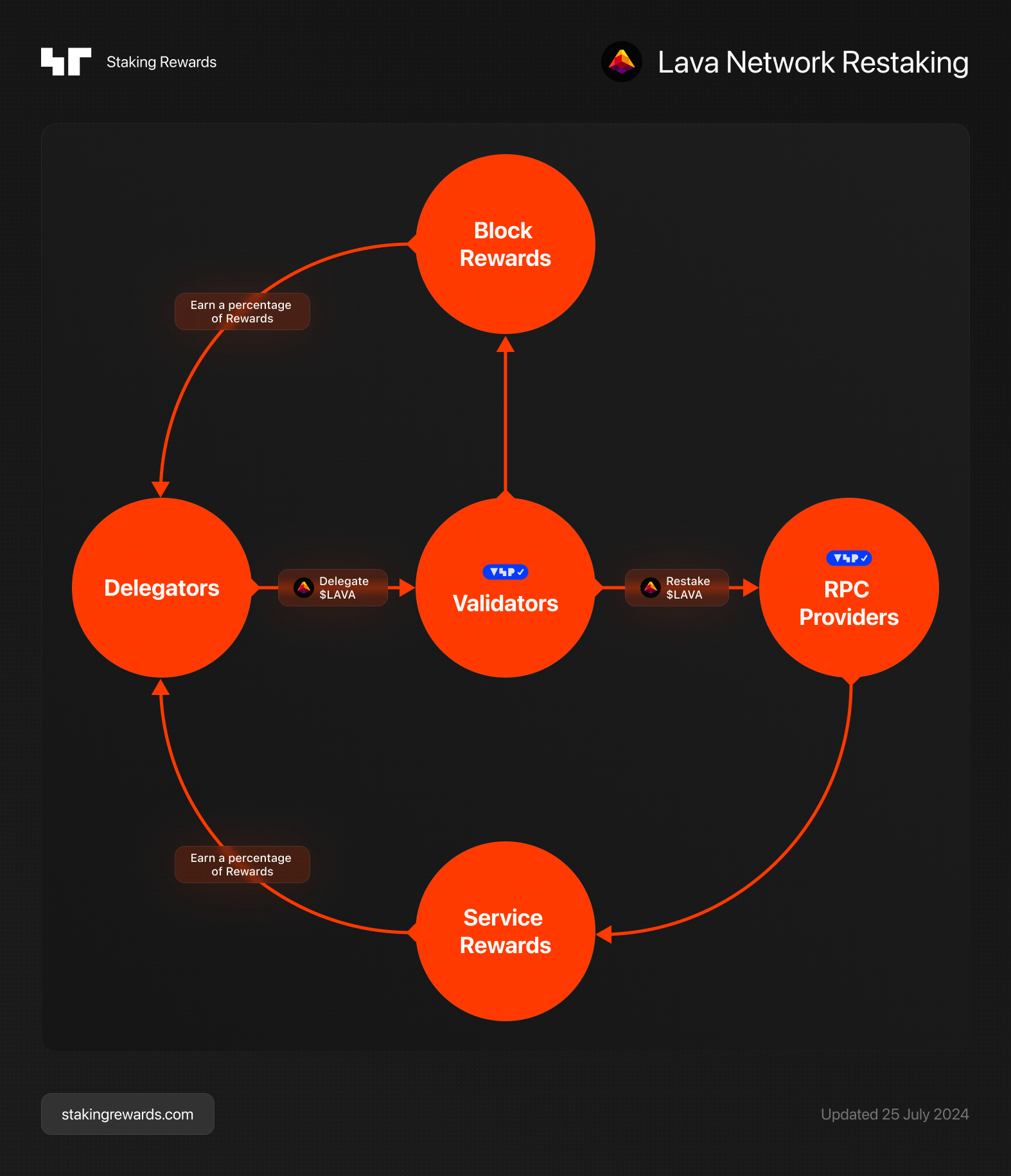
Lava Network Incentives
There are 5 types of rewards on Lava and each is distributed across different actors. All % are determined by and can be changed by DAO governance.
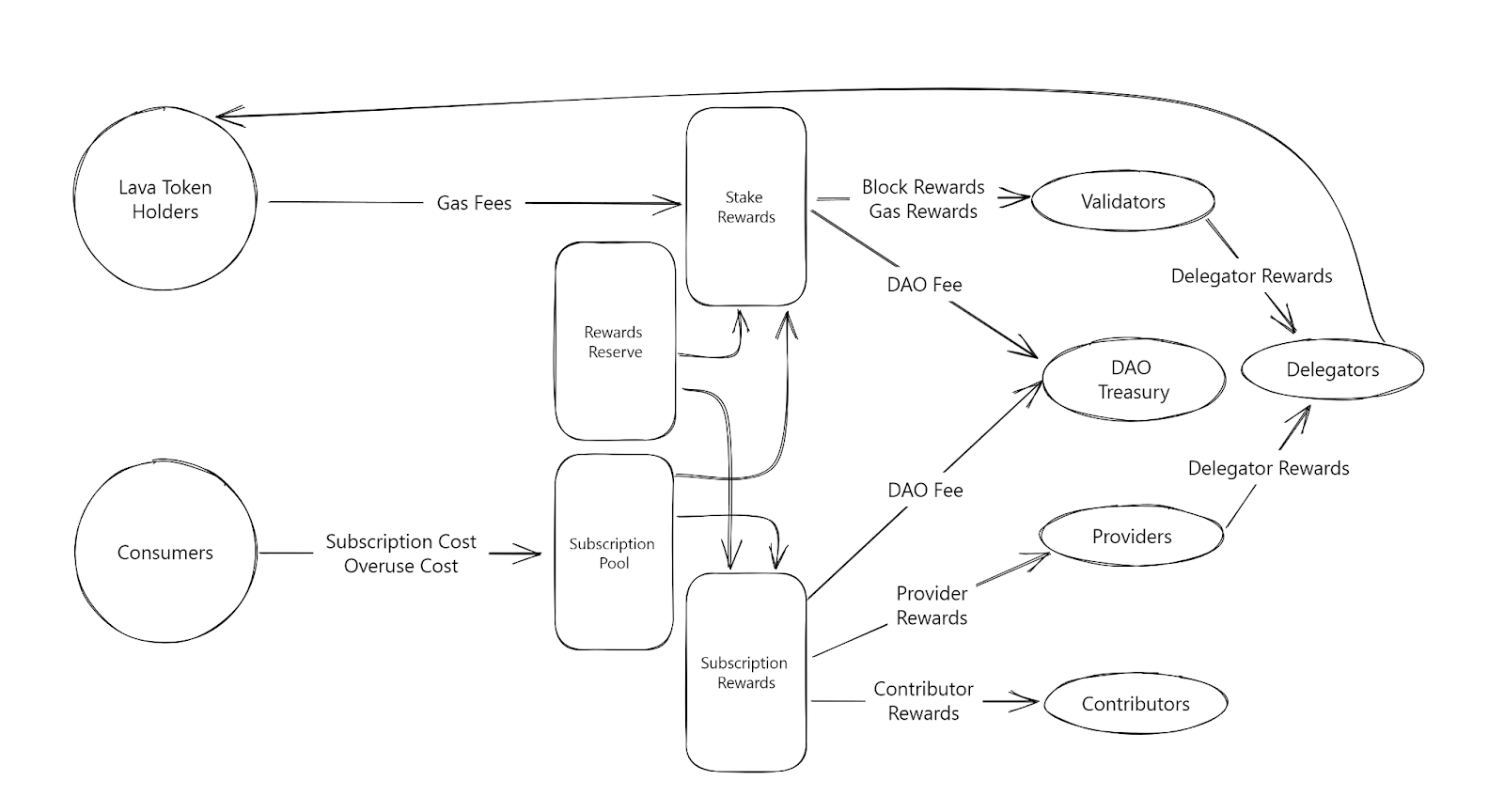
Subscription-Based Rewards
- Consumers purchase subscriptions using LAVA tokens.
- After one month, the subscription fees are distributed as follows:
- 95% to providers, delegators, and champions.
- 4.9% to validators and their delegators.
- 0.1% to the community pool.
Subscription rewards in the first four years can be boosted up to 6 times from the pre-minted rewards pool, depending on the decentralization level of usage.
Incentivized RPC Pools
- These pools can hold any token, which is then bridged to LAVA.
- After one month, payouts follow the same distribution structure:
- 95% to providers, delegators, and champions.
- 4.9% to validators and their delegators.
- 0.1% to the community pool.
There is no boost for rewards from these pools.
Block Rewards
- Pre-minted block rewards are distributed monthly as follows:
- 98% to validators and their delegators.
- 2% to the community pool.
Transaction Fees
- Additional fees are collected from transactions within the network, further incentivizing network participants and ensuring continuous operation and development.
What is the LAVA Token?
The LAVA token is the native asset of the Lava Network, designed to power its decentralized RPC and API access layer. The token serves as the primary medium for transactions, staking, governance, and rewards within the Lava ecosystem. By holding and using LAVA tokens, participants in the network can engage in a variety of roles and activities, ensuring the network's security, functionality, and growth.
Stakers play an important role in the network by determining which RPC Providers receive the most rewards. By collectively staking into the top-performing RPC Providers, they enhance the network's resilience and overall quality.
You can use Stake Now by Staking Rewards to stake LAVA. Follow our LAVA staking guide to get familiar with the process.
Utilities of the LAVA Token
LAVA tokens have several key utilities within the network:
Subscription Payments
Consumers buy subscription plans in LAVA tokens to access a diverse set of API specifications via the Lava Protocol. These plans are priced by governance and vary based on the compute units and specifications they offer.
Staking
Validators and providers stake LAVA tokens to secure the network and offer services. Validators stake to participate in block creation and governance, while providers stake to ensure the integrity of their service and gain eligibility for accepting delegations and servicing requests.
Native Restaking
Token holders can delegate to validators and then restake their LAVA tokens with providers. This helps improve network performance because top providers attract more stake, and higher stake increases your request handling frequency. Restaking also enhances capital efficiency and maximizes token utility.
Governance
Token holders participate in on-chain governance, influencing decisions such as pricing subscription plans and defining API specifications.
Rewards
Providers, validators, and champions earn rewards in LAVA tokens. Providers receive rewards based on the volume of relays they serve, validators earn from block rewards and fees, and champions receive commissions for maintaining and developing API specifications.
Tokenomics of LAVA
Lava Network operates on a fixed supply model with a total of 1,000,000,000 LAVA tokens (1 billion) at genesis and no inflationary mechanisms. The token distribution is designed to foster network growth, incentivize early participation, and ensure long-term sustainability. The LAVA token allocation presents the following distribution:
| Category | Description | Allocation |
| Public Allocation | Future initiatives and Rewards Reserve (Provider Drops and Validator rewards) | 25% |
| R&D & Ecosystem | Protocol Maintenance & Development; Programs for Providers, Validators, and Champions | 31% |
| Investors | Early Supporters of Lava | 17% |
| Contributors | Early contributors, Core Team, Advisors, & Others | 27% |
Lava Network has raised $26M across two founding rounds in since inception. Its development attracted renowned investors, including Hashkey Capital, Jump Capital, Animoca Brands, and more. Lava Network raised $11M in the strategic round and $15M in the seed round to support RPC infrastructure.
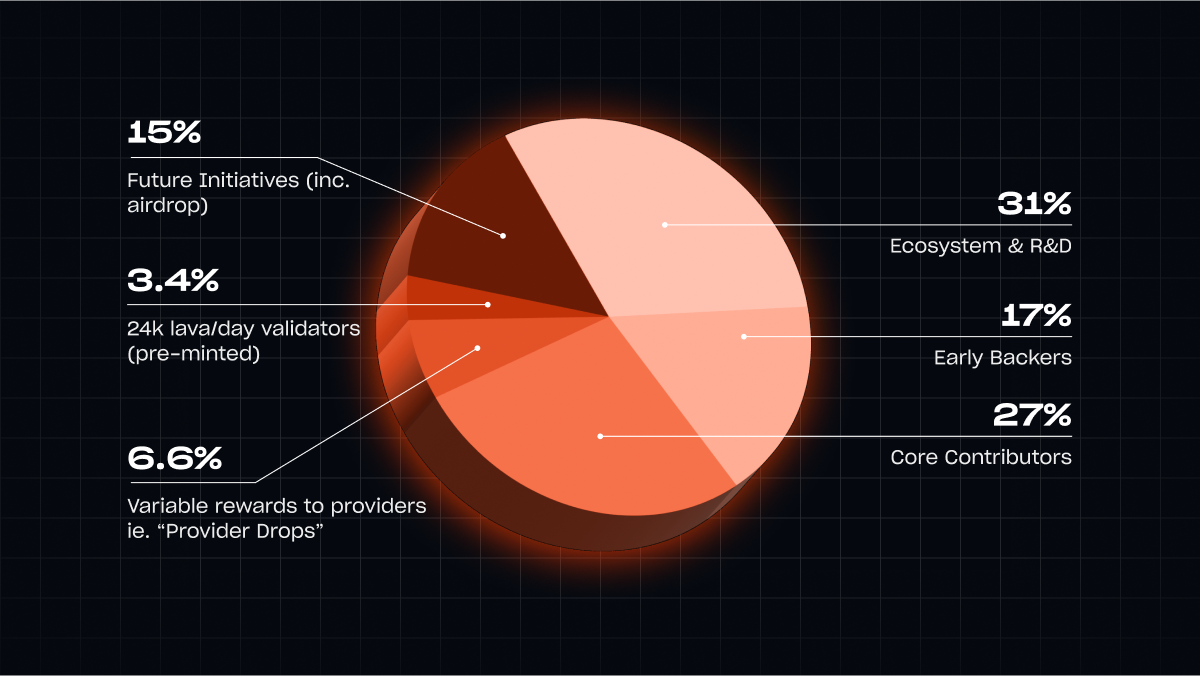
Key aspects of LAVA tokenomics include:
Provider Drops
6.6% of the total supply is allocated for monthly "Provider Drops," a reward mechanism to bootstrap early marketplace supply-side (provider) participation. These rewards vary based on paid demand for services.
Subscription Rewards
95% of subscription fees collected in LAVA are distributed to providers and their delegators, incentivizing high-quality service. Validators and their delegators receive 4.9%, and 0.1% goes to the community pool.
Block Rewards
A fixed 3.4% of the total supply is distributed monthly as block rewards over four years, with undistributed rewards burned to align validator interests with network efficiency.
Conclusion
Lava Network has built a solution to address the challenges of data access in a multi-chain era. The advent of multiple blockchains and rollups has led to fragmentation, creating a complex developer experience. By providing a unified access layer, Lava simplifies the process of interacting with multiple blockchains, enhancing both developer and user experiences and making it easier for newer rollups to grow their ecosystem.
Lava Network's innovative staking mechanism allows token holders to delegate LAVA to validators for network security and restake to providers, enhancing service quality and capital efficiency. This dual-staking approach ensures a robust and decentralized ecosystem, incentivizing optimal performance from both validators and providers.
Lava's modular and flexible approach allows for the rapid integration of new chains and APIs, fostering innovation and reducing barriers to entry. This adaptability ensures that Lava can support a broad range of ecosystems, from top L1s and L2s to emerging chains. As a result, Lava Network is poised to become a critical infrastructure layer in the expanding blockchain ecosystem, driving the next wave of decentralized applications.
The network provides superior redundancy and resiliency compared to a single provider. Its permissionless and decentralized nature allows it to leverage support from a diverse, open-source community of contributors and providers.

More from Research




Institutional-Grade Research
Delivered to Your Inbox
Join 12,000 institutional allocators worldwide. No spam, unsubscribe anytime.