Solana After Alpenglow: What Changed on the Network
TL;DR;
- Alpenglow reduced Solana’s block finality from about 7 seconds to under a quarter of a second.
- Shifts in slot speed and transaction counts trace to other causes, while validator counts and staking yields were largely unchanged.
On October 21, Solana’s Alpenglow upgrade cut the network’s block finalization time from about 7 seconds to under a quarter of a second. We measured that change and checked four other numbers from around the same time:
- slot speed
- transaction counts
- validator counts
- staking yields
This post analyzes each of the five metrics using data we pulled directly from the Solana network between October 21 and November 12. Most figures come from a single public data server and small samples, so they show the size of each change rather than exact network-wide values.
What Alpenglow changed
Blockchains need a way for validators to agree on which blocks are considered final. Until the Alpenglow upgrade on October 21, Solana used a system called TowerBFT. Validators voted by sending transactions that were recorded in blocks, and a block counted as final once enough votes had stacked up over the next 32 slots.
Alpenglow’s first phase, called Votor, replaced that system. Validators now send votes directly to each other, outside of blocks, and bundle them into certificates. A block can be final after one or two rounds of voting. [1][4]
For users, “final” is the point at which a transaction can no longer be reversed. Exchanges, payment apps and bridges wait for it before treating a transfer as settled. That wait is what Alpenglow reduced.
Transactions are executed the same way as before. Alpenglow’s second phase, Rotor, is a new way of spreading blocks across the network. It is not live yet. [1]
How much faster is finality?
To measure the change in finality speed, we watched a public Solana data server through the switch on October 21. For each new block, we timed how long it took to go from processed, when it first appears, to finalized, when the network has agreed it can’t be reversed.
In the half hour before the switch, that took a median of 6.93 seconds. Right after, it took 0.20 seconds. A check the next day came in at 0.17 seconds. A follow-up on November 12, covering 2,796 blocks, came in at 0.18 seconds, with 80% of blocks finalizing between 0.13 and 0.35 seconds.
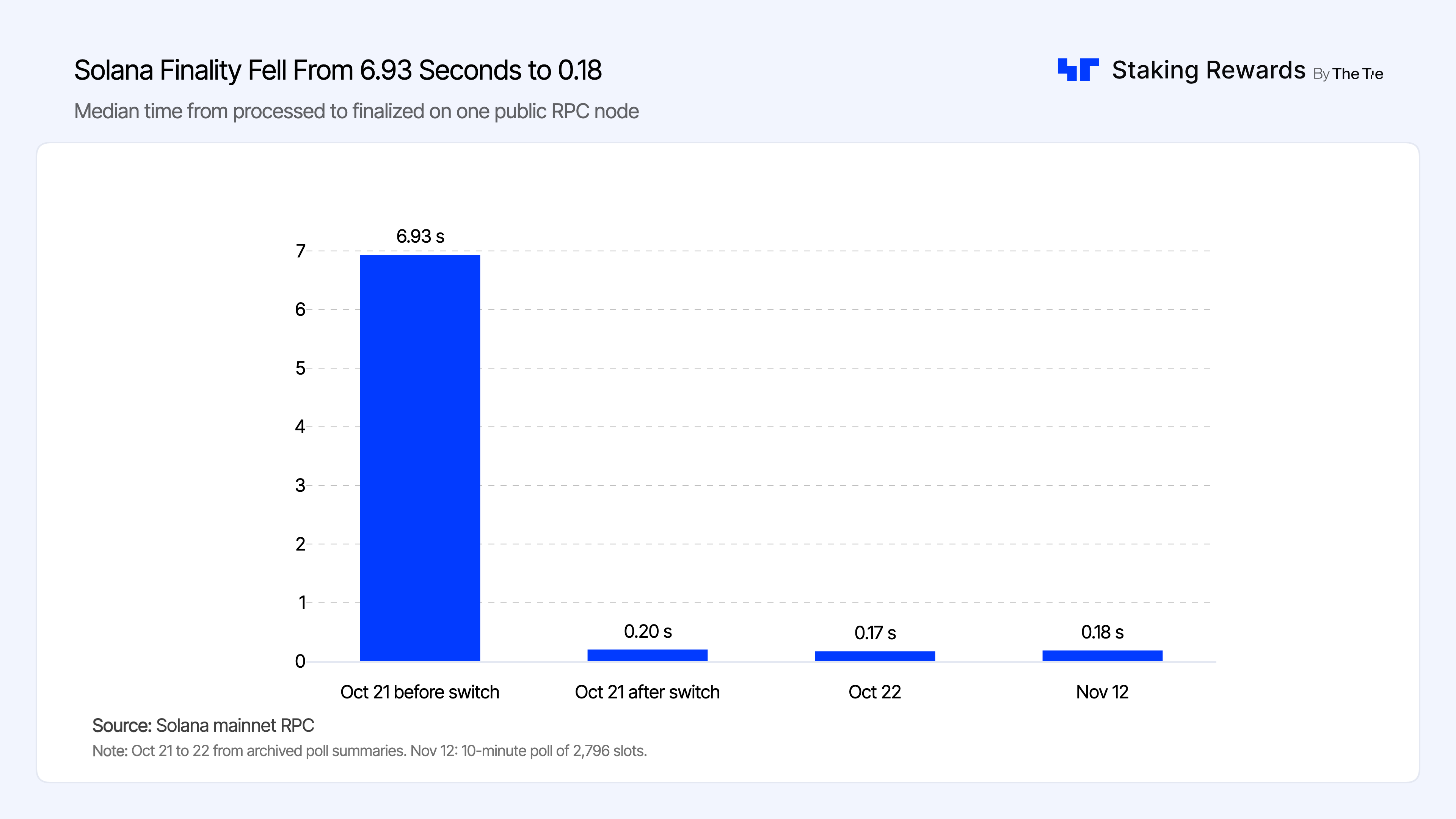
Finality on Solana is more than 30 times faster than before the upgrade, and the change held three weeks after launch. In slots, the finalized block used to trail the newest block by 32 slots, the stack of votes TowerBFT required. Now it trails by just one.
These figures show the size of the change but not an exact speed. They come from one node’s view of the network rather than every validator’s. The clock also starts once a block is processed, so the time it takes to send a transaction in the first place is not included. And the fastest times are shorter than the gap between our checks of the server, so we estimated them.
Is Solana producing faster blocks too?
Alpenglow wasn’t the only upgrade to Solana’s speed this fall. In the weeks before it went live, a separate upgrade, SIMD-0525, was shortening Solana’s slots, cutting the target slot time from 400 to 200 milliseconds in four steps between August 21 and October 9. [2] Because the two arrived so close together, we checked whether Alpenglow itself made blocks come faster, or whether that gain came from SIMD-0525. The data points to SIMD-0525.
The shorter slots also explain why our “before” finality measurement was about 7 seconds rather than the often-quoted 12.8 seconds. Under TowerBFT, finality took 32 slots. At the original 400 milliseconds per slot that was 12.8 seconds, but at roughly 215 milliseconds it was about 7.
To see how slot times moved, we measured the average slot time in every epoch, a period of about a day, from late September to November 12. Slots averaged 268 milliseconds before the 200-millisecond target took effect on October 9, and 217 milliseconds between then and Alpenglow, a 19% drop. Since Alpenglow, they have averaged 214 milliseconds.
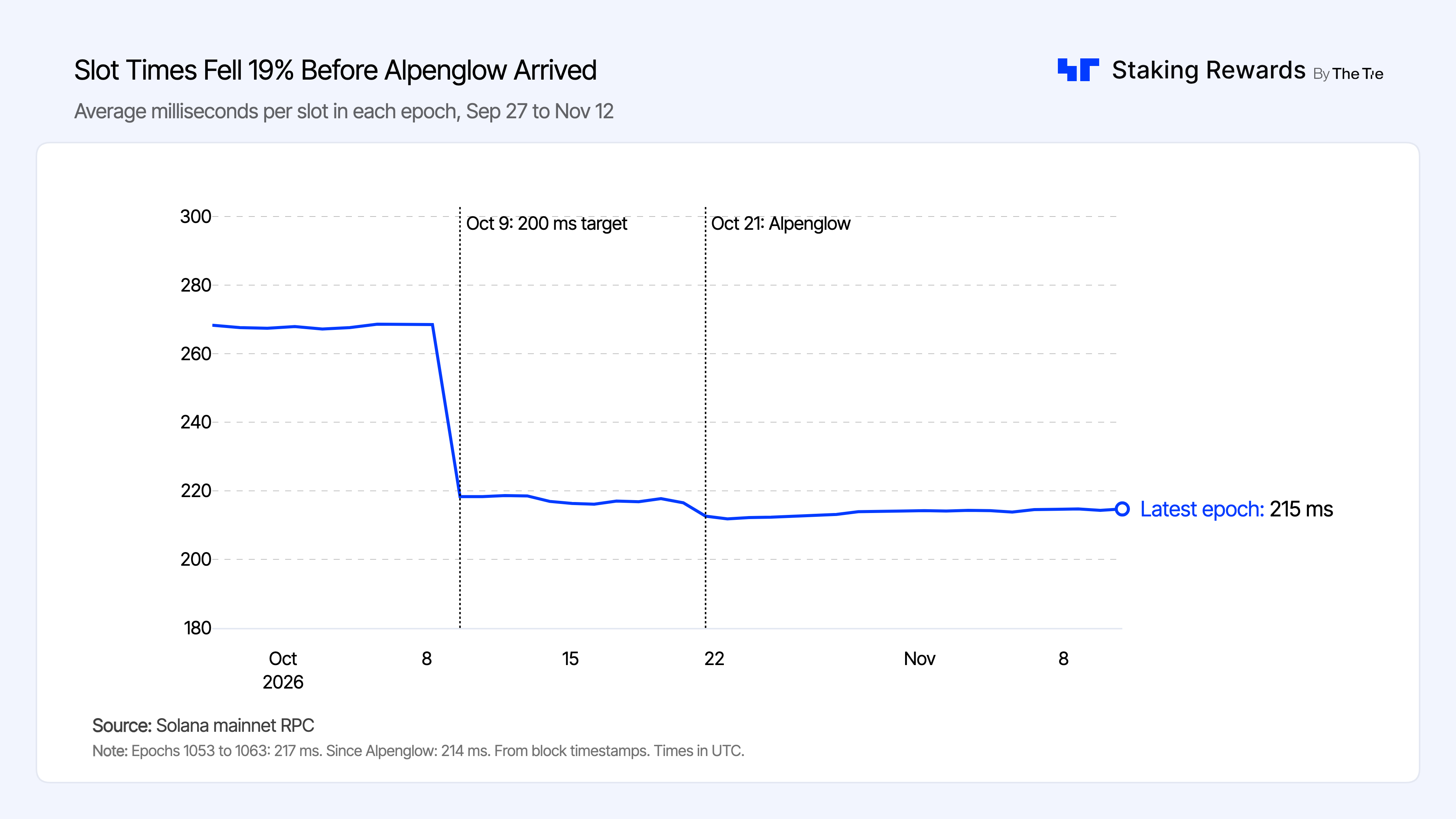
Nearly all of the gain arrived with the October 9 target, two weeks before Alpenglow. Since then, slot times have barely moved. The small dip after October 21 shouldn’t be read as an Alpenglow effect either, because Alpenglow also changed how the network records the timestamps we used.
Faster slots also don’t mean Solana can process twice as many transactions. SIMD-0525 shrank the amount of work allowed in each slot in step with the shorter slot time, so the work the network can do per second stays about the same. [2]
Why did Solana’s transaction count fall?
Any chart of Solana’s total transactions shows a sharp drop on October 21. That isn’t necessarily a drop in activity. Under TowerBFT, every validator vote was a transaction recorded in a block, and votes made up most of what was in each block. Alpenglow moved votes out of blocks, so they no longer show up in transaction counts. Solana’s own upgrade notes tell anyone tracking the network to reset any metric that counted them. [1]
To see how big that effect is, we sampled 12 random blocks from every epoch. Both periods come after the 200-millisecond slot target, so the change in slot length doesn’t skew the comparison. Before Alpenglow, the 132 blocks we sampled held an average of 1,065 transactions: 657 votes and 408 others. After, the 228 blocks held an average of 368, and none were votes.
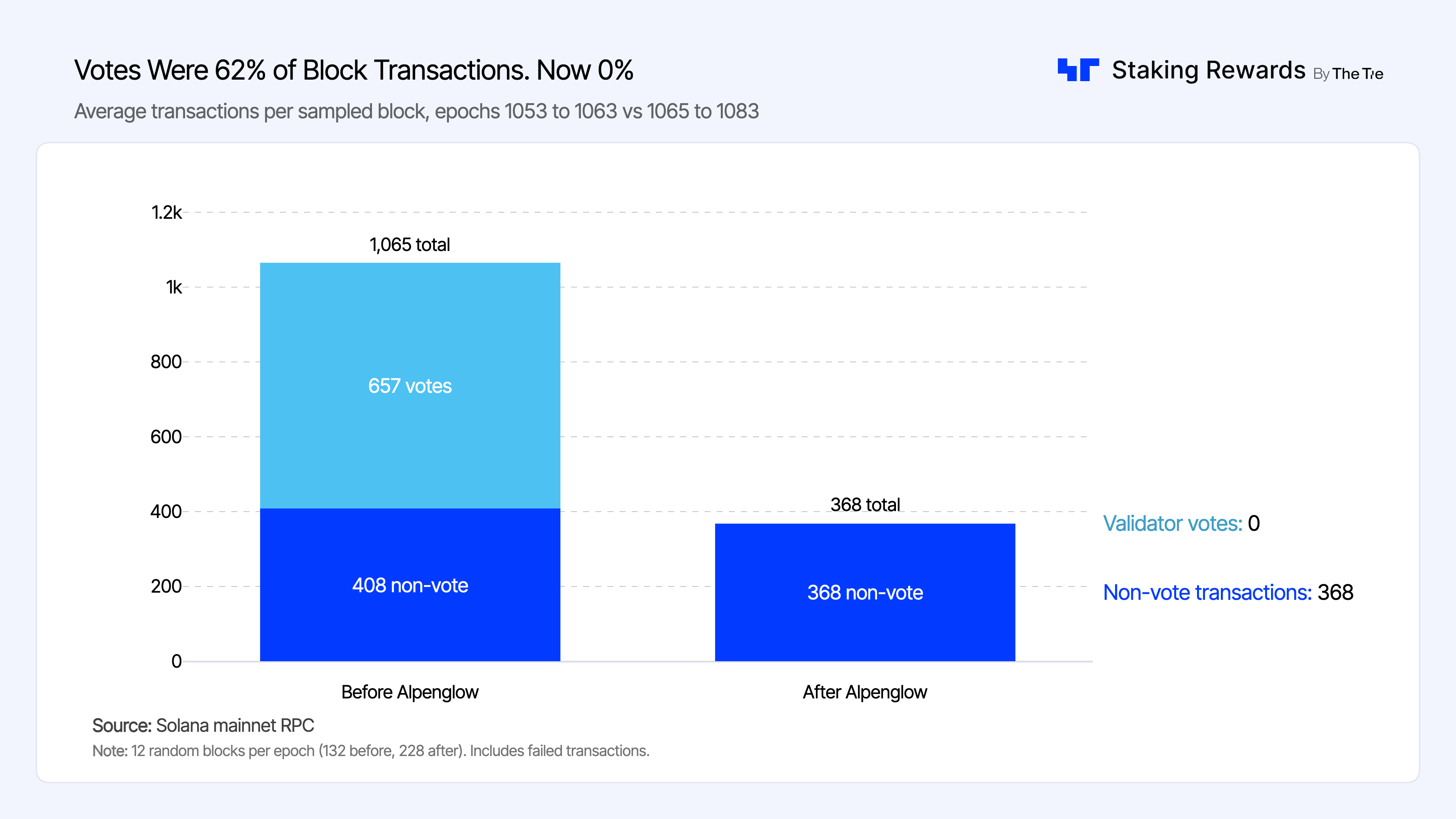
Votes were 62% of the transactions in a typical block, and removing them accounts for nearly all of the drop. The fairer comparison is the non-vote transactions on each side, the ones that come from apps, bots and users: 408 per block before and 368 after.
That non-vote figure was about 10% lower after the switch. Our sample is too small to say whether Alpenglow had anything to do with it, and a per-block count doesn’t measure activity across the whole network. Non-vote transactions also include failed ones, so they aren’t a count of users or successful actions.
Did the number of validators change?
Alpenglow also changed what it costs to take part in consensus. Validators no longer pay fees on vote transactions. Instead, each pays a flat admission fee of about 0.8 SOL per epoch. A shift in costs could, over time, change how many validators the network has, so we checked whether the count had moved.
In the three weeks after launch, it didn’t move much. We compared two snapshots of Solana’s validator accounts that have stake delegated to them, one taken the day after the switch and one three weeks later. On October 22 there were 676: 666 voting normally and 10 marked delinquent, meaning they had fallen behind or gone offline. On November 12 there were 698: 660 voting normally and 38 delinquent. [3]
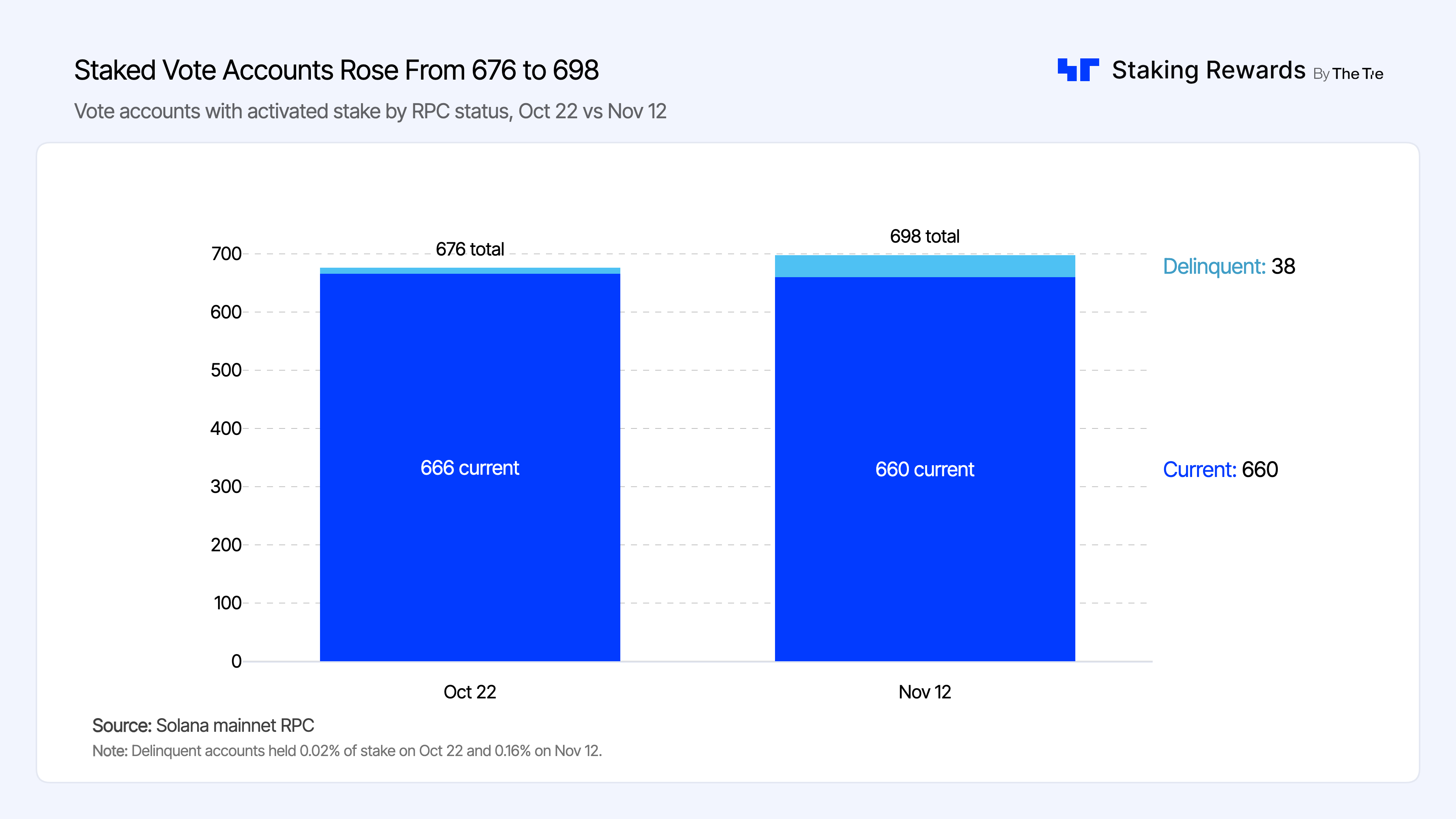
The total rose by 22, while the number voting normally dropped by six. The delinquent accounts carried very little stake, 0.02% of the total on October 22 and 0.16% on November 12, so almost all stake stayed with validators that were voting normally.
Two snapshots can’t show a trend and both were taken after the switch, so they don’t compare the network before and after Alpenglow. A validator account also isn’t the same as a validator business, since one operator can run several. Whether Alpenglow’s new costs change who runs validators will take a longer record to tell.
Did staking yields change?
The last question is the one stakers care about most: did Alpenglow change what they earn? In our sample, it didn’t.
Most of a native SOL staker’s return comes from new SOL the network issues every epoch, and Alpenglow didn’t change how much is issued. SIMD-0525 also adjusted the issuance math for shorter slots, so the yearly inflation rate stays the same. [2]
To check this against real payouts, we tracked the rewards paid to 43 stake accounts at 11 validators, from just before the switch (epoch 1062) to November 4 (epoch 1077). Each validator’s average reward rate after Alpenglow stayed within 0.17 percentage points of its rate before. Across the 43 accounts, the median of each account’s average annualized reward rate was approximately 5.23% both before and after Alpenglow.
These figures are adjusted to remove validator commission, so they aren’t the net rates delegators received. A staker’s actual return still depends on their validator’s commission, its uptime and any extra rewards it shares, such as MEV tips.
What did change is how much rewards move from one epoch to the next. Before the switch, accounts paying 5% commission had annualized reward rates of 4.94%–4.97% after commission, calculated from individual epochs. Afterward, those rates ranged from about 4.1% to 5.9%, while their average remained close to the earlier level. One epoch is now a poor guide to what a delegation earns, so it’s worth looking at several.
The sample is small and includes only two epochs before the switch. It shows that yields didn’t shift in any noticeable way, not that they are exactly the same across the whole network.
Conclusion
Alpenglow achieved what it was built to do. Solana now finalizes blocks in under a quarter of a second instead of about 7, and that held three weeks after launch.
The other numbers that moved around October 21 have different explanations. Faster slots came mostly from SIMD-0525, two weeks earlier. Transaction counts fell because votes left blocks, not because activity did. Validator counts barely moved in the weeks after launch, and staking yields stayed where they were, though they now swing more from one epoch to the next.
Anyone comparing Solana data across October 21 should keep those apart: the network settles far faster, but our data doesn’t show it getting busier, larger or more rewarding to stake because of Alpenglow.
Sources and method
All figures come from Solana’s public data server (mainnet RPC), pulled between October 21 and November 12, 2026.
- Finality: block status checked one to three times a second on October 21, October 22 and November 12, with times between checks estimated; 66 of 1,474 requests failed in the November 12 run.
- Slot times: block timestamps at each epoch boundary, epochs 1044 to 1083.
- Transactions: 12 random blocks per epoch, excluding the switch epoch (1064); a transaction counts as a vote if it uses Solana’s Vote program, and failed transactions are included.
- Validators: snapshots of vote accounts with stake on October 22 and November 12.
- Yields: actual reward payouts to 43 native stake accounts. The before-and-after median compares account-level average annualized rates, adjusted to remove validator commission, across epochs 1062–1063 and 1065–1077; transition epoch 1064 is excluded. The ranges for accounts paying 5% commission are annualized rates after commission. Figures exclude MEV tips, liquid staking tokens and exchange products.
[1] Solana Foundation: Alpenglow activation, design and indexing changes.
[2] SIMD-0525: Reduce Slot Times.
[3] Solana RPC: getVoteAccounts.
[4] SIMD-0326: Alpenglow.
Disclaimer: This article is for information only and is not investment advice.

More from Featured


Institutional-Grade Research
Delivered to Your Inbox
Join 12,000 institutional allocators worldwide. No spam, unsubscribe anytime.