Staking ETFs Compared: Allocations, Fees and Exit Times
US exchange-traded products increasingly stake the tokens they hold. We compared them on what separates one staking ETF from another: how much of the fund is actually staked, how much of the reward the sponsor and providers keep, how quickly the fund can get staked tokens back and who stakes them.
Background
Staking is a growing feature of US spot crypto ETPs, giving investors exposure to both token prices and staking rewards. Products now span Ethereum, Solana and several newer networks. Recent launches from Morgan Stanley in July and from Canary and Bitwise in September have expanded the range of options.
The “staking ETF” label covers products that work quite differently. Two funds holding the same token can stake different proportions of their holdings, deduct different amounts from rewards and take different approaches to managing redemptions. Those details affect how much staking income reaches shareholders and how readily a fund can access its assets.
This report compares those differences using SEC filings, prospectuses and issuer disclosures. It covers a selected sample of US spot crypto ETPs. Not every fund discloses every figure, so the funds shown vary from chart to chart. Staked-share figures are dated to when each issuer reported them, and fee and product details were checked through October 13, 2026.
How much of the fund is actually staked?
Every staking fund makes a trade-off. Staked tokens earn rewards once active, while unstaked tokens let the fund meet redemptions without waiting on the network. The size of that unstaked buffer is therefore an important part of our comparison, alongside the reward rate and fees.
Staked shares differ mainly because each fund sets its own liquidity policy. ETHB normally targets 70% to 95% staked and 21Shares’ TETH generally 40% to 70%, while Morgan Stanley’s MSSE targets 50% to 80% and MSOL can stake up to 100%. Network withdrawal rules, fund flows and operational needs also play a role, and actual allocations can sit outside a target. The figures below are dated issuer observations: most are from October 12 or 13, FSOL’s is from its June 30 filing, and each fund’s date is shown on the chart.
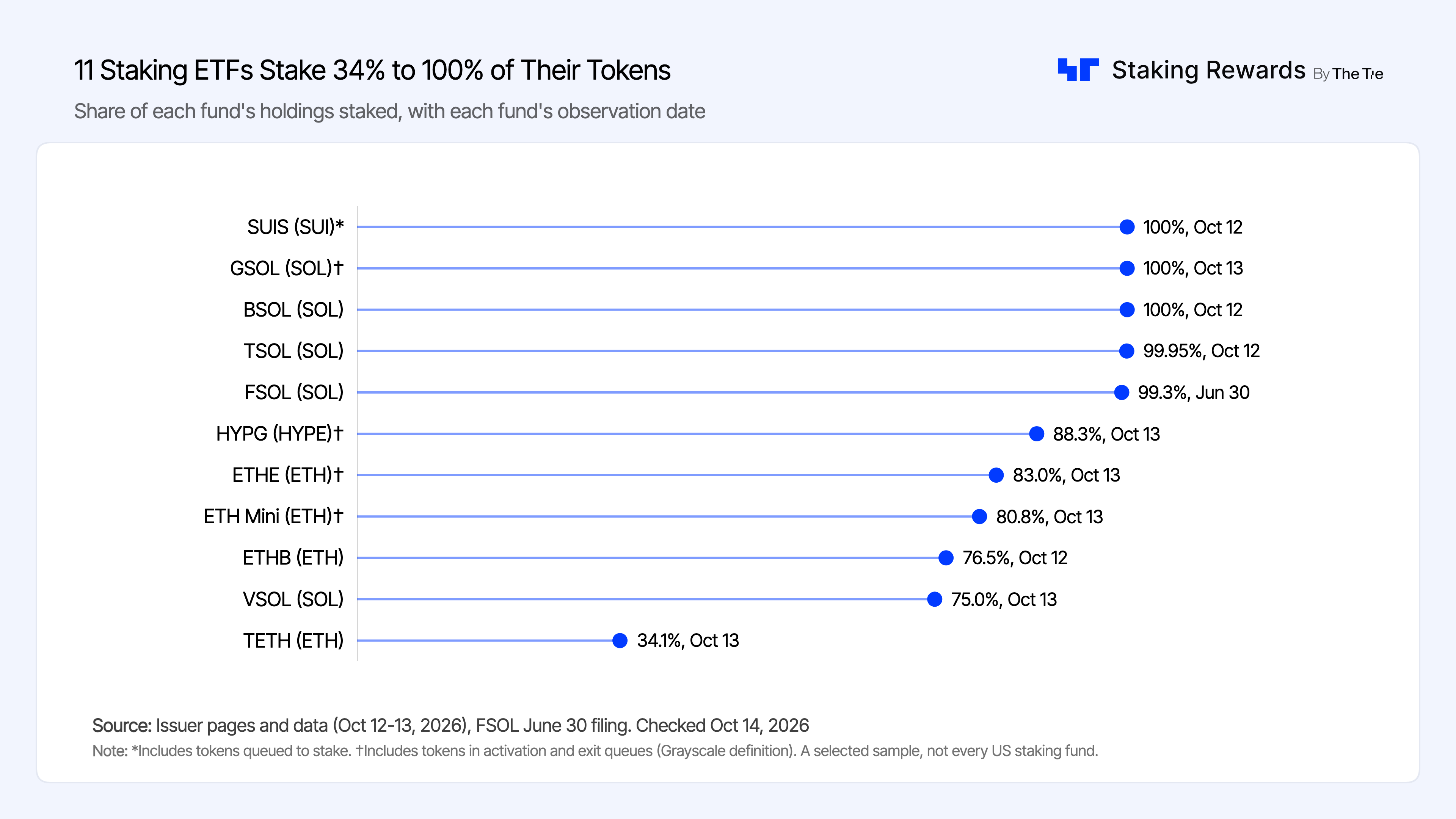
Four of the five Solana funds were close to fully staked, while VSOL and the Ethereum funds kept larger unstaked buffers. Reported allocations can also include tokens moving in or out of staking: SUIS counts tokens queued to stake, and Grayscale’s figures include tokens in activation and exit queues, so a reported allocation need not equal the share actively earning rewards.
The gap can be wide even for the same token, and it matters for returns. ETHB staked about three-quarters of its ether and TETH about a third, so at the same reward rate ETHB’s holdings would earn more than twice the staking income, before fees. TETH, in turn, kept a larger buffer to meet redemptions without waiting on the network.
How much of the staking reward reaches investors?
The share of holdings a fund stakes is only part of the return calculation. Fees determine how much of the resulting income reaches shareholders. Most funds charge an annual sponsor fee plus a staking fee, usually a percentage of gross rewards deducted before the balance reaches the fund.
VSOL uses a different basis: its staking provider charges 0.28% a year on the fund’s staked assets, in addition to the 0.30% sponsor fee, so that fee cannot be compared directly with fees expressed as a share of rewards.
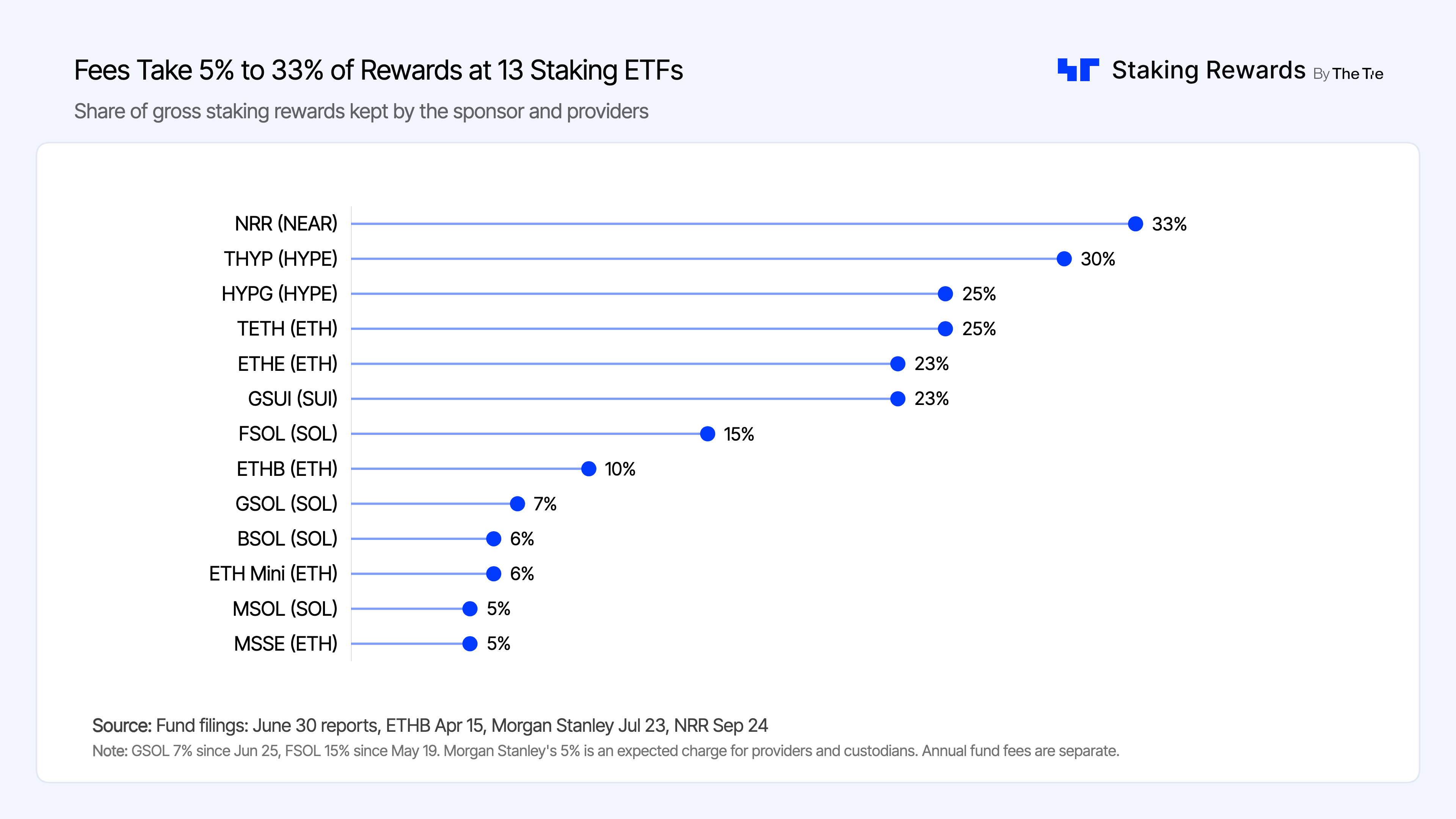
Among the funds shown, reward deductions range from an expected 5% at Morgan Stanley’s funds, paid to staking providers and custodians, to 33% at NRR. These are aggregate deductions. They include the service providers’ shares and, except at Morgan Stanley, where the sponsor takes none, the sponsor’s share.
Fees can differ substantially even within the same issuer. Grayscale’s Ethereum Staking Mini ETF (ETH) deducts 6% of staking rewards and charges a 0.15% annual sponsor fee, while ETHE deducts 23% and charges 2.50%. Their staked allocations were similar on October 13, at 80.8% and 83.0%, so the fee difference matters even when the funds put a similar share of their holdings to work.
Terms also change. ETHB cut its reward deduction from 18% to 10% in April and GSOL from 23% to 7% in June, while FSOL began charging its fees on May 19 when its waivers ended.
How much a deduction costs depends on the reward rate. The table below isolates the deduction: annual staking income on $10,000 of staked tokens at three hypothetical gross annual reward rates of 2%, 4% and 6%
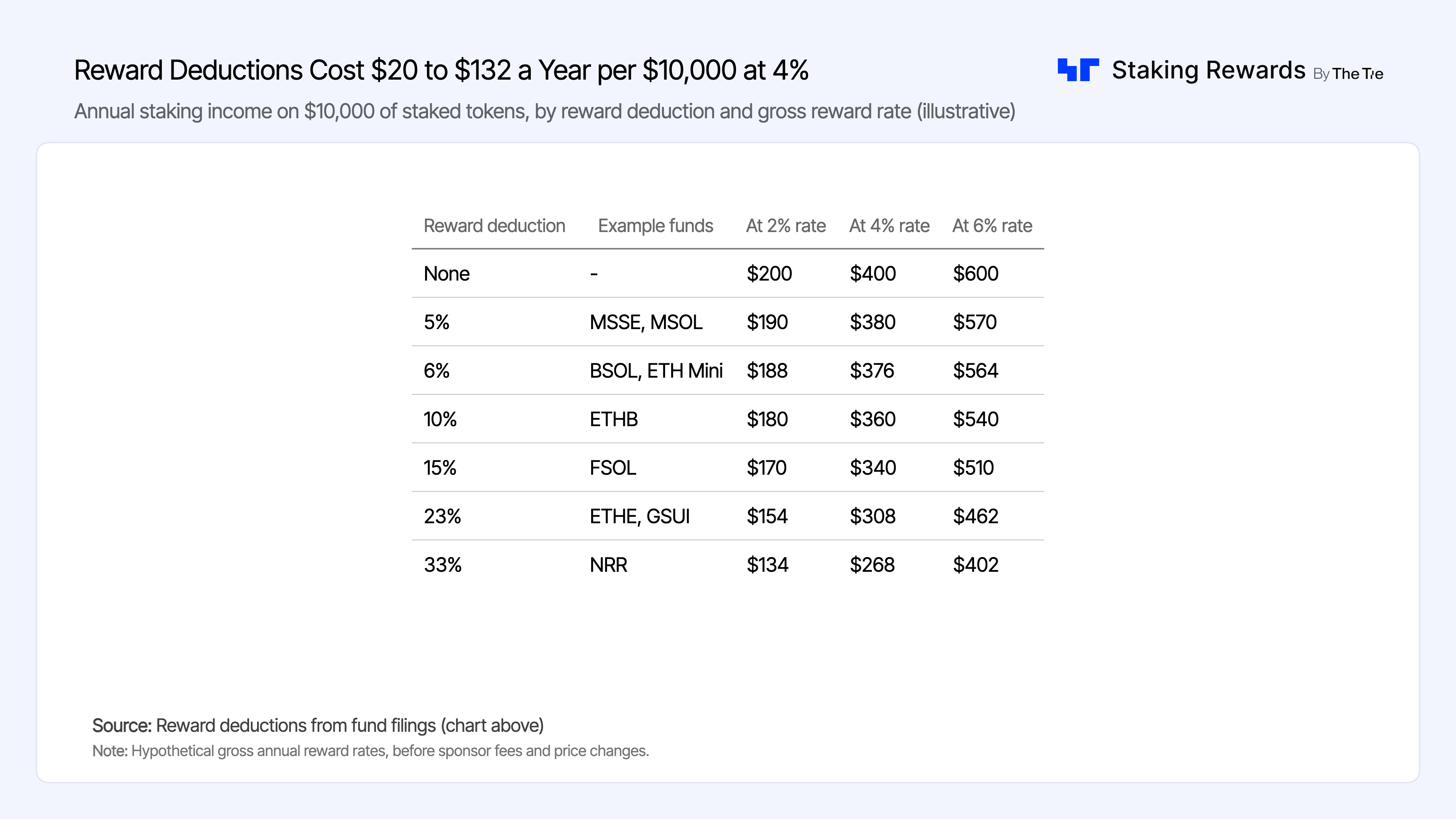
For a whole fund, the effect also depends on how much is staked. At a 4% reward rate, a 23% deduction lowers the return from staking by 0.92 percentage points if every token is staked, and by about 0.74 points with 80% staked. Sponsor fees, other costs and token price changes affect returns as well.
How fast can a fund can get its tokens back?
Investors can generally sell ETF shares during exchange trading hours. Behind that trade, the fund faces a separate liquidity question: how quickly can it access tokens committed to staking?
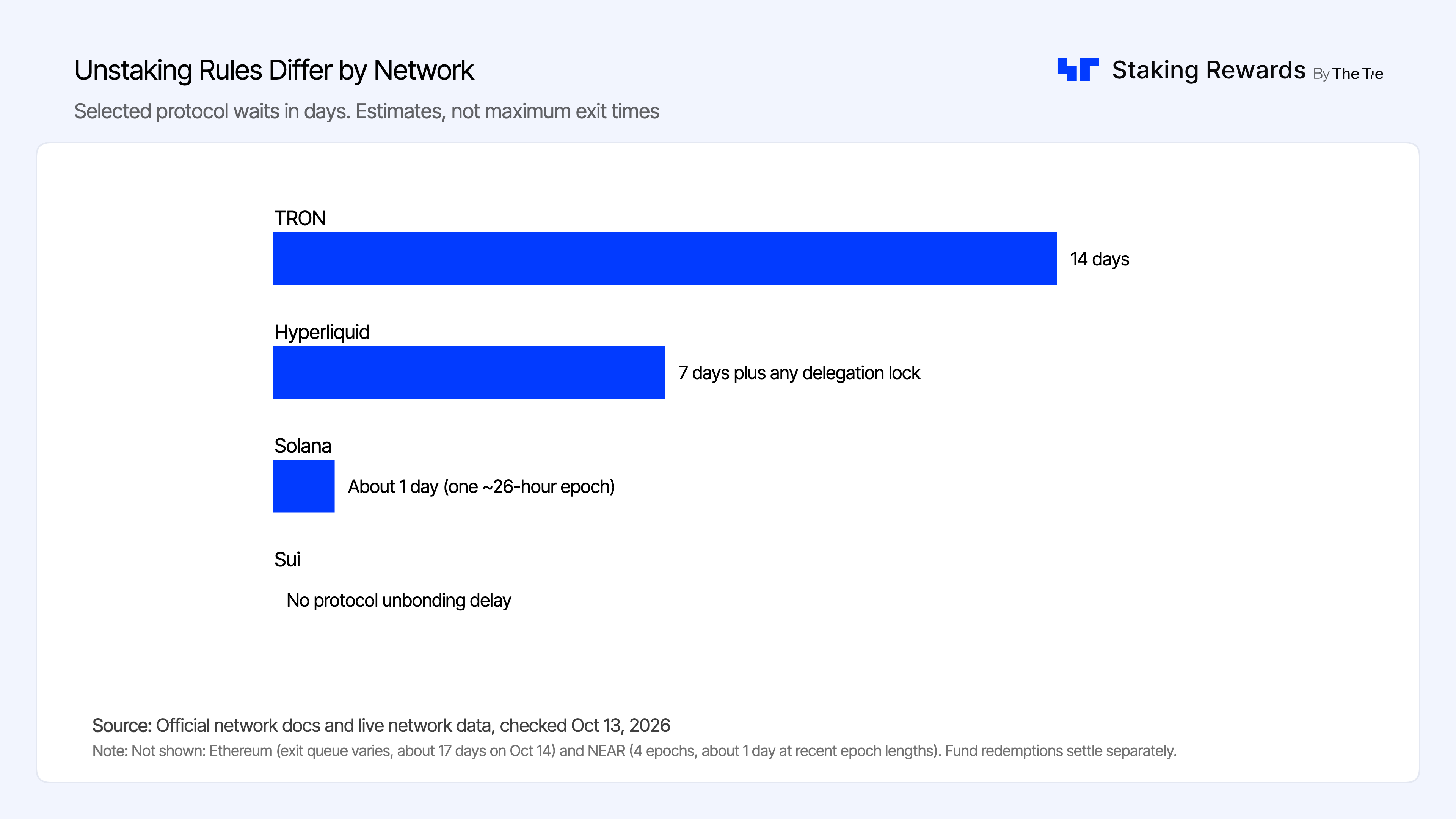
Each network has its own withdrawal process, which shapes how large an unstaked buffer a fund keeps:
- Sui has no protocol unbonding wait. An unstaking transaction returns principal and accrued rewards, though rewards are earned only for full epochs.
- NEAR releases unstaked tokens after four epochs, roughly one day at recent epoch lengths. Bitwise’s prospectus for NRR estimates about 48 hours under normal conditions.
- Solana deactivates stake at the next epoch boundary, and an epoch has lasted about 26 hours since the network moved to faster slots on October 9. Fund filings written before then estimate two to four days, and network-wide cooldown limits can stretch the process over several epochs.
- Hyperliquid has a seven-day withdrawal queue, plus any remaining one-day delegation lock.
- Ethereum’s wait varies with demand, as validators pass through an exit queue, a withdrawability delay and a withdrawal sweep.
- TRON has a 14-day unfreeze period, which can be changed through governance.
- Avalanche commits stake for a chosen term. September’s Helicon upgrade cut the minimum staking period to 48 hours and added automatic renewal, but delegations still require at least two weeks.
These rules matter most when redemptions exceed a fund’s unstaked holdings. ETHB’s prospectus warns that requests above its liquidity sleeve can delay settlement and, in extreme cases, lead to a temporary suspension of redemptions. That makes liquidity policy an important counterpart to allocation and fees when comparing funds.
Who stakes for the ETFs?
Behind each fund is a set of firms responsible for custody and staking. Custodians safeguard the tokens, while staking providers handle the infrastructure used to earn rewards. Some issuers manage staking in-house while others rely on external providers, and a firm can play more than one role.
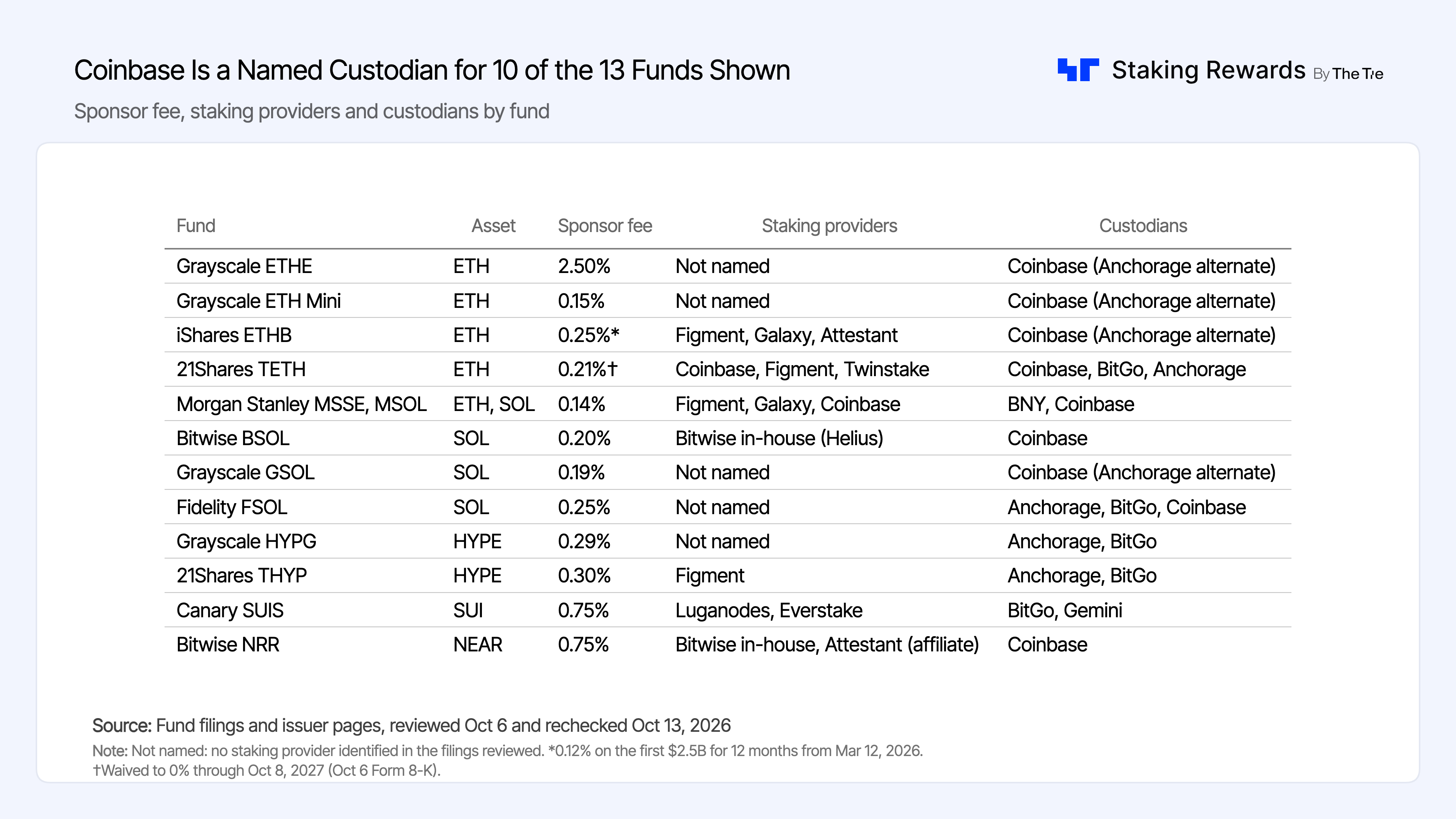
One firm stands out. Coinbase is named as a custodian for 10 of the 13 funds shown, across six of the seven issuers, so choosing a different issuer does not necessarily mean choosing a different custodian.
That count is based on the firms named in filings, which do not always show who actually holds or stakes the tokens. Fidelity’s FSOL, for example, lists several permitted custodians without saying how its holdings are divided among them. Other filings name a custodian without identifying the staking provider, or name an alternative custodian that the sponsor does not currently plan to use.
Custody, staking, prime brokerage and administration are also separate roles, even when the same firms appear across several products. For ETHE, the Mini and GSOL, for example, Coinbase Inc. serves as prime broker and BNY as administrator and transfer agent, separately from the funds’ token custodians.
For more detail on individual staking firms, Staking Rewards maintains a provider directory.
Conclusion
Staking ETFs can differ substantially even when they hold the same token. How much a fund stakes and what it charges determine how much staking income reaches shareholders, while withdrawal rules and liquidity policies shape how the fund meets redemptions. Staking income also varies over time, some networks can penalize validator faults, and changes in token prices can outweigh staking income. Comparing those details alongside the firms responsible for custody and staking gives investors a clearer picture of what each product offers.
Sources: SEC filings, issuer disclosures and official protocol documentation, with observation dates stated individually. Updates checked through October 13, 2026. This article is for information only and is not investment advice.

More from Featured

Institutional-Grade Research
Delivered to Your Inbox
Join 12,000 institutional allocators worldwide. No spam, unsubscribe anytime.