Drop: Unlocking Liquidity on the Interchain


TL;DR;
- Drop Protocol: A cross-chain liquid staking solution for Cosmos SDK-based chains, that allows users to liquid stake on Cosmos SDK chains. Drop is launching with dATOM, a liquid represetation of staked ATOM.
- Liquid Staking with Drop: Users can mint dATOM by liquid staking idle ATOM, making their existing staked position liquid whilst retaining any rewards from staking.
- Validator Preferences : When stake with Drop on the Stake App, users can choose to spread their delegation amongst all Drop validators or to delegate to a specific validator. Specific validator staking is exclusive to stakingrewards.com.
- Droplets Program: Earn rewards and governance power through the Drop ecosystem by participating in liquid staking and using dAssets.
Native delegation on Cosmos SDK based chains is both a blessing and a curse.
Delegation allows you to stake tokens and earn rewards without running your own validator, supporting network health while generating passive income. However, the 21-day unbonding period for native staking on Cosmos SDK chains creates liquidity issues, limiting quick access to funds and DeFi participation.
Drop is a new protocol that brings liquid staking to the Cosmos ecosystem. With Drop, users can make their native delegation liquid whilst retaining all of their rewards from staking (think of Lido for Cosmos SDK chains).
In this article we take a closer look at Drop and why the liquid staking protocol may provide the key to unlocking liquidity on the Interchain.
What is Drop?
Drop is a cross-chain liquid staking protocol that uses CosmWasm contracts to manage assets across multiple blockchains via IBC, Interchain Transactions, and Interchain Queries. With Drop, users can liquid stake their assets or make their existing staked positions liquid. When a user deposits a supported asset, Drop mints a liquid staking token called a dAsset using the Token Factory standard.
The protocol can be integrated into external UIs or DeFi platforms on Neutron or any IBC-connected chain. Using it involves three key actions: staking, requesting to unstake, and withdrawing unstaked assets, along with queries to manage these processes.
Initially, Drop is launching with dATOM, a liquid staking token representing staked ATOM on Cosmos Hub. This will be followed by dTIA and other Cosmos SDK-based assets. This article focuses on dATOM.
How Staking with Drop Protocol Works
Drop enables liquid staking for assets on the Cosmos and Osmosis networks, with the output liquid staking token (or dAsset) living on Neutron. This setup requires transferring tokens between chains, but thanks to IBC-hooks, this process is streamlined. IBC-hooks, a powerful tool for cross-chain swaps, allow the IBC-transfer to call Drop’s contract via the IBC-hooks module on Neutron, using middleware to complete the transfer. This can be done from both the Cosmos and Osmosis networks. The hooks bundle all necessary steps into a single transaction, so users don't have to manage multiple actions.
One of the big differentiators with Drop, is its approach to distributing stake. Instead of competing with validators, Drop works with them to provide a liquid staking solution that offers them a slice of the pie.
The Three Ways to Liquid Stake with Drop
There are three different ways users can mint dATOM, depending on the user’s preference and their starting point.
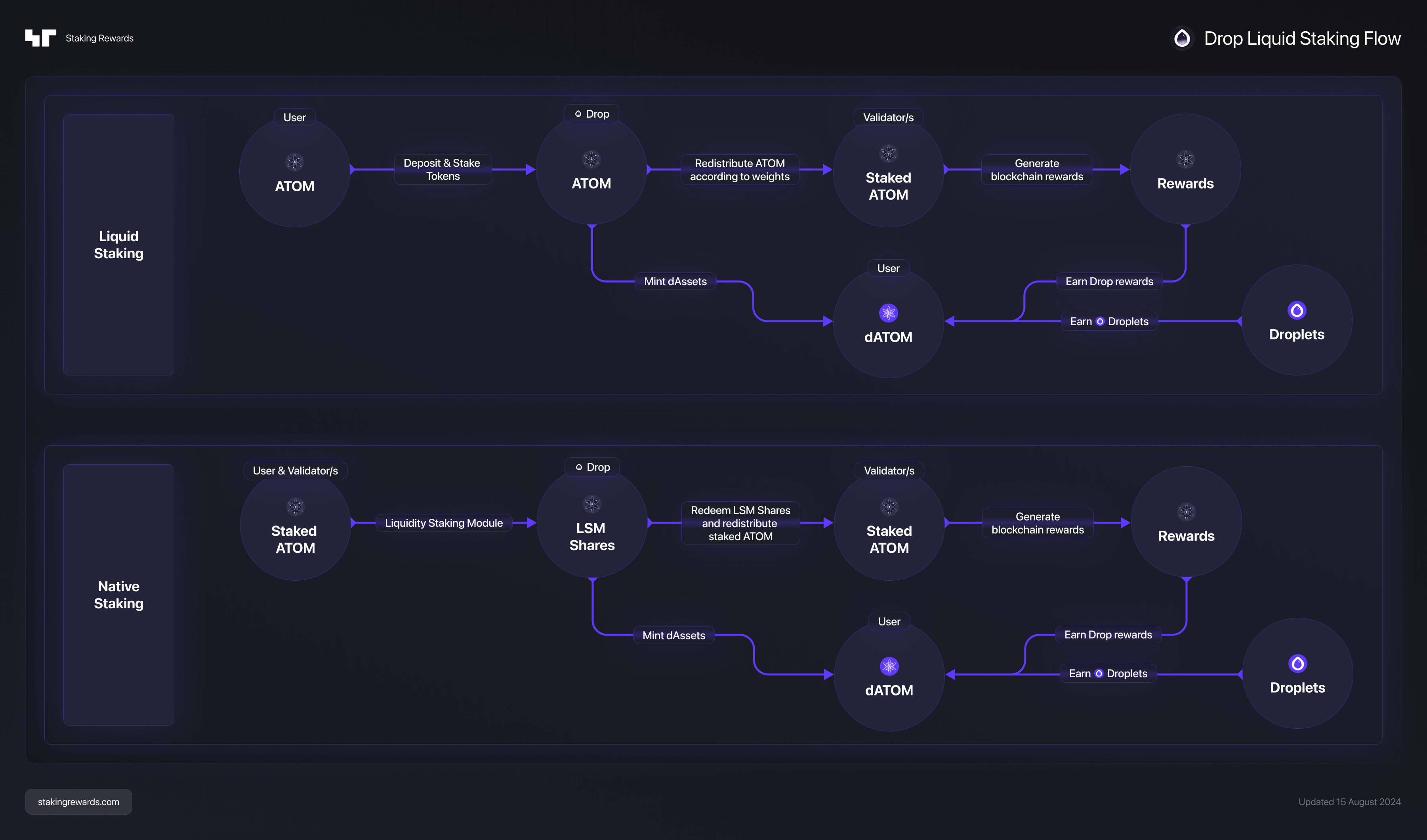
- Deposit ATOM to mint dATOM and distributed the underlying stake evenly to all validators in Drop’s set
- Deposit ATOM to mint dATOM and distributed the underlying stake to an individual validator within Drop’s set (exclusive to stakingrewards.com/stake-app)
- Mint dATOM using your existing staked ATOM to make your stake liquid.
Liquid Staking to a All Validators
When the user chooses “All” in the UI, Drop allocates the assets based on the pool's validator weights, which are updated weekly. Drop works with 30 validators, including Chorus One, Stakecito, Provalidator, P2P, and Cosmostation.
Liquid Staking to an Individual Validator
The user also has the option to liquid stake with Drop, and assign the weighting of the underlying asset to a individual validator. To do this, instead of selecting "All", the user can select their validator preference via the filter in the Stake App UI.
Liquid Staking Using an Existing Staked Position
Another way to mint dATOM is by liquid staking ATOM that is already staked to a validator. If users have already staked ATOM via a wallet like Keplr or Leap, they can use the Staking Terminal to convert those staked tokens into dATOM. The dashboard in the Staking Terminal simplifies the process, allowing users to liquify specific positions with chosen validators.
No matter which method of staking you choose, Staking Rewards streamlines the entire process, handling token transfers, minting LSM shares, staking, and minting dATOM, all in one place with minimal steps.
What Happens to my Staked ATOM?
Once ATOM tokens are staked, Drop uses another powerful module called the Liquidity Staking Module (LSM). LSM allows users to move their staked assets between addresses without the need to unstake them. This method should appeal to validators who don’t want to lose delegators to other staking providers. Thanks to the LSM and setting up validator preferences, users will be able to obtain liquid dATOM tokens, while ATOM is staked with the selected validator or validators. With LSM, you can assign new ownership of the shares to receive rewards. For the users without preference, mostly those who haven’t staked yet, the Drop Protocol spreads the stake between listed validators according to the weight in a pool.
How Unstaking with Drop Protocol Works
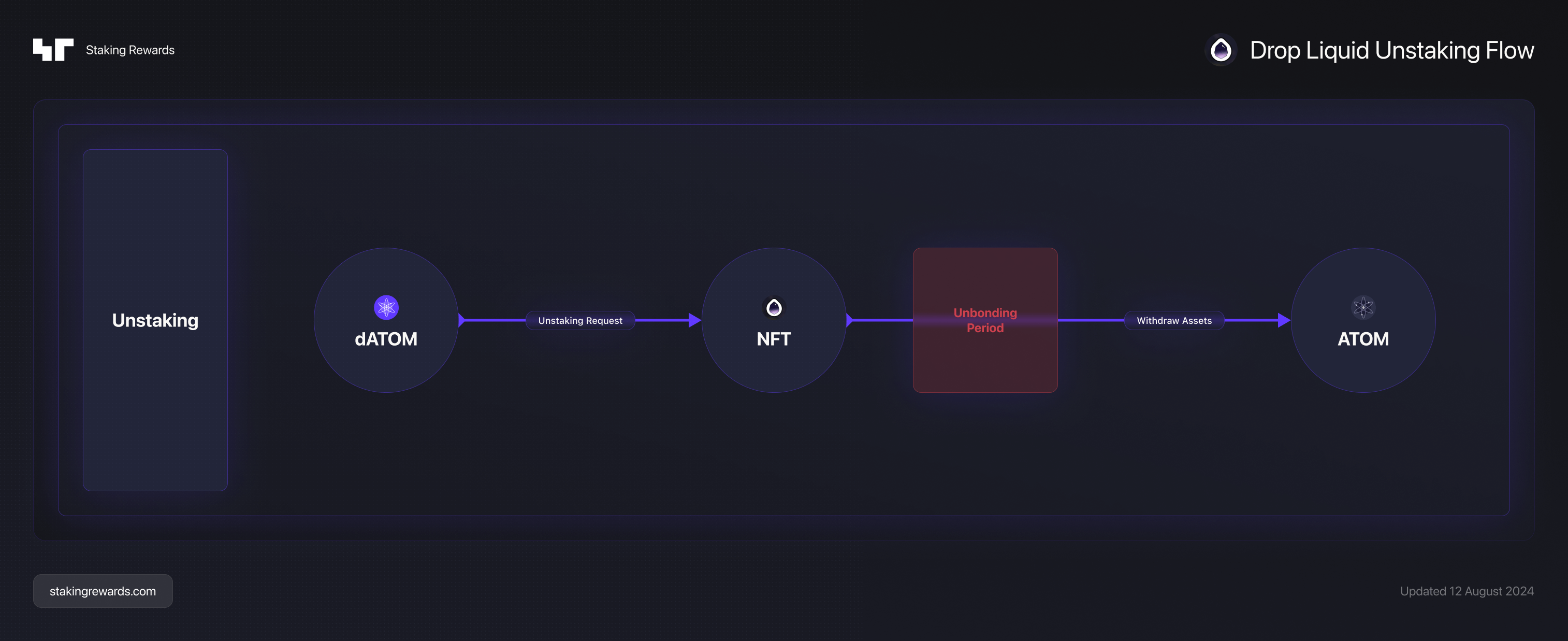
When a user unstaked dATOM, they initiate an unstaking request to the core contract with an unbonding message. The contract burns the dASSET and mints an NFT that details the unstaking amount. After the 21-day unbonding period, this NFT allows users to withdraw their ATOM.
A future plugin will simplify this process by enabling automatic withdrawals. By providing an additional gas token and locking their withdrawal NFT in a special contract, the system will automatically process the withdrawal. This planned enhancement will allow users to unstake their assets without manually withdrawing them.
The Power of the Liquidity Staking Module (LSM)
The staked ATOM position can be represented by the LSM shares. The module’s biggest party piece - the possibility to mint shares based on staked ATOM and change ownership - is the crucial part of Drop’s liquid token. User mints LSM shares from their current delegated position, which are later deposited into the Drop smart contract and managed according to the user validator preferences. Similarly to ATOM, the IBC-transfer calls Drop the contract via the IBC-hooks module on Neutron, but with an asset attached as an LSM share instead of the native token. At this point, it is worth noting that, the already staked ATOM can be liquified with Drop only if it was produced by a validator from the Drop validator list. Drop smart contract mints new dASSET based on the LSM shares.
The Droplets Program (Drop Points)
The Droplets Program, supported by Drop’s expanding ecosystem, aims to coordinate market participants to maximize Interchain's economic welfare and measure their contributions to the protocol's success. Participants can earn Droplets, which will be distributed from a pool of 100,000,000 DROP tokens, by liquid staking, using dAssets in ecosystem applications, and referring friends. When the program concludes, Droplet holders will receive DROP tokens and become founding members of the Drop DAO, playing a crucial role in the protocol's governance and the management of the Drop Treasury.
The Droplets Program starts on Drop’s launch day and consists of several earning methods: liquid staking assets like ATOM to receive dAssets and earn daily Droplets based on their value, using dAssets in the Drop ecosystem to multiply earnings and refer friends to gain additional bonuses. The program is divided into epochs, each lasting 1-4 weeks, with new earning opportunities introduced regularly. An airdrop of DROP tokens will be given to participants, with smaller holders receiving their full airdrop immediately, while larger airdrops will vest over six months, retaining full voting power in the Drop DAO during the vesting period. Read more about the Droplets campaign here.

More from Research

Institutional-Grade Research
Delivered to Your Inbox
Join 12,000 institutional allocators worldwide. No spam, unsubscribe anytime.