Two Months After: Dencun Upgrade's Impact on Ethereum
TL;DR;
- Dencun Upgrade: Launched March 13th on Ethereum mainnet.
- Improvements: Enhanced network scalability and reduced transaction costs.
- Components:
- Cancun: Uses EIP-4844 for efficient "shard blob transactions."
- Deneb: Employs EIP-7514 to strengthen consensus and stabilize validators.
- Results: Overcame early compatibility issues, achieving 96% validator compliance in one month, boosting network stability and managing validator growth.
An eagerly awaited Ethereum upgrade named Dencun, or Deneb-Cancun, was implemented on the mainnet on March 13th. It focused on enhancing the network's scalability and making transactions cheaper. Key improvements include reduced gas fees, bolstered security, and optimized data storage, with the goal of making Ethereum more cost-friendly for rollups.
In this article, the Everstake team analyzes the upgrade's key novelties and how the chain changed a month after its implementation.
The Dencun Upgrade Explained
The Deneb-Cancun upgrade, implemented on March 13, 2024, was a significant advancement for the Ethereum blockchain. It wasn't one singular upgrade but rather a combination of updates, fixes and changes on different layers working together: Cancun and Deneb.
Cancun: Streamlining Transactions
- Cancun targets the execution layer, with the main changes focused on optimizing how transactions are processed.
- Introduced EIP-4844, a proposal enabling "shard blob transactions" for increased Ethereum efficiency.
Deneb: Strengthening Consensus
- Deneb tackles the consensus layer, which is how network participants agree on the blockchain's state.
- Implemented EIP-7514 to add a maximum epoch churn limit, a technical detail but important for maintaining network stability.
While the above mentioned EIPs were the most discussed features, there were actually 3-5 more updates on each layer. Find out a more detailed overview in our dedicated article.
Challenges and Success of the Upgrade
While Dencun was one of the most highly anticipated upgrades since the Merge, core updates began development well before. EIP-4844 was a headlining feature that introduced blob storage and has been creating buzz since its hackathon inception at Ethereum Denver in February 2022.
At the time of the actual upgrade, however, with nearly 980,000 validators active at the time of the upgrade, only 79% were compatible with the client version supporting Dencun. Thankfully, the network only requires ⅔ validator agreement to finalize blocks. This initial lack of compatibility put the importance of timely updates in the limelight once again.
At the time of writing, 96.75% of validators are compatible, which isn't bad for just a month after the upgrade. But there's still 3.25% that might never get upgraded.
The reason is that after the upgrade, if a node hasn't been updated, the validators won't be able to communicate with its peers, participate in Ethereum's consensus, etc. Seems like, if a node has not been upgraded during a month after a fork, meaning it does not perform its duties and receive rewards for so long, it never would be.
EIP-4844: Shard Blob Transactions
EIP-4844, also known as proto-danksharding, implements a new transaction type to Ethereum that accepts "blobs" of data to be stored temporarily in the beacon node.
Blobs are a type of data structure that allows the storage of large, unstructured data. In the context of Ethereum, blobs are essential for improving the network's capacity and efficiency, specifically in handling large volumes of data. This mechanism aims to ease the strain on the network’s bandwidth and improve overall transaction throughput.
By separating essential data from the main chain, the network can process more transactions efficiently. Offloading data storage was expected to decrease overall transaction costs.
How effective this measure turned out to be can be judged from the numbers:
- Blob usage experiences daily growth, saving more ETH for users
- There were 417k blobs altogether in 100k blocks and over 211k blob transactions
- 38.69% of Ethereum blocks now have blob transactions
- Daily blob transactions average at 2.5 to 3k
Notably, with the initial blob cost of several Gwei (under $0.01), in a week after the implementation, blobs saved 96 ETH (about $325,000 at current prices) and 189 ETH (or about $676,000) in two weeks. The total economy by the time of writing comprised 685 ETH (over $2 million). This averages the economy at about 15-16 ETH a day, corresponding to about $50,000.
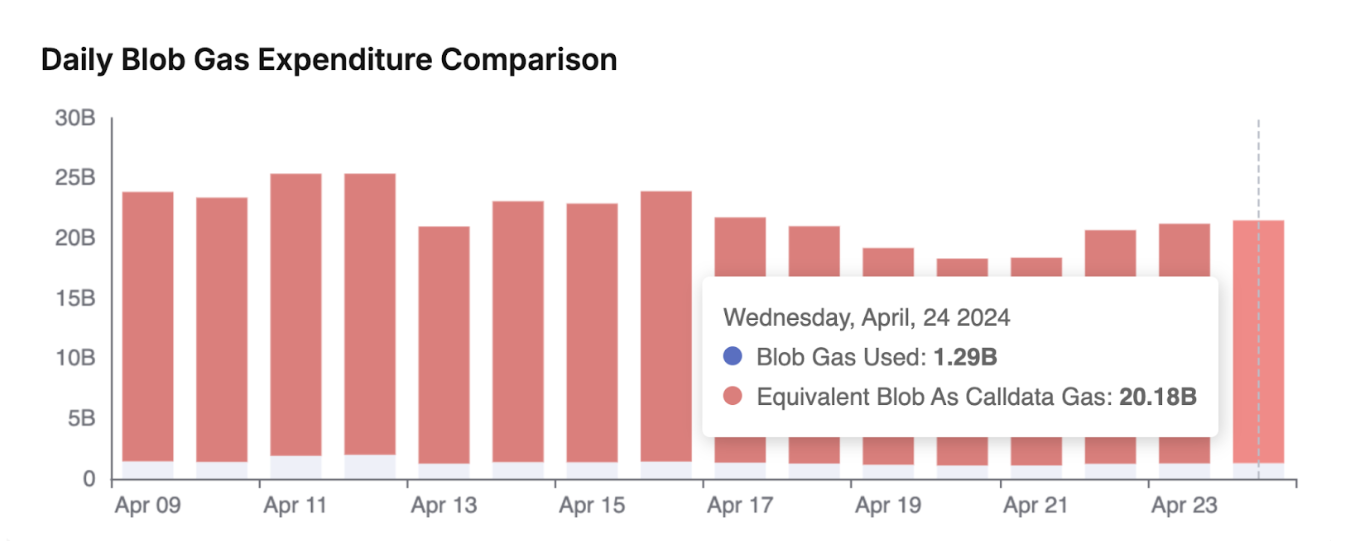
Over the period in question, the “blobscription” seemed to pose the biggest challenge to users, with the blob base fee going from 1 wei to 650 billion wei. At times, the blob base fee per gas exceeded the execution base fee many times over. On April 4, the blob base fee per gas went back to 1 wei. That said, even the peak prices were lower than those for calldata.
EIP-7514: Add Max Epoch Churn Limit
EIP-7514 appeared after the new staking highs resulted in exponential validator growth, which, in the long run, will likely aid network stability, finality, and economic health. It was then that many of us discovered the concept of the “churn limit.”
The churn limit refers to the maximum number of validators that can be swapped in or out of the active validator set per epoch.
EIP-7514 is designed to stabilize the validator set on the Ethereum Beacon Chain. Its key goal is to slow down validator growth from an exponential rate to a more controlled, linear increase to prevent potential instability.
The activation queue dynamics after Dencun went live are shown on the table below.
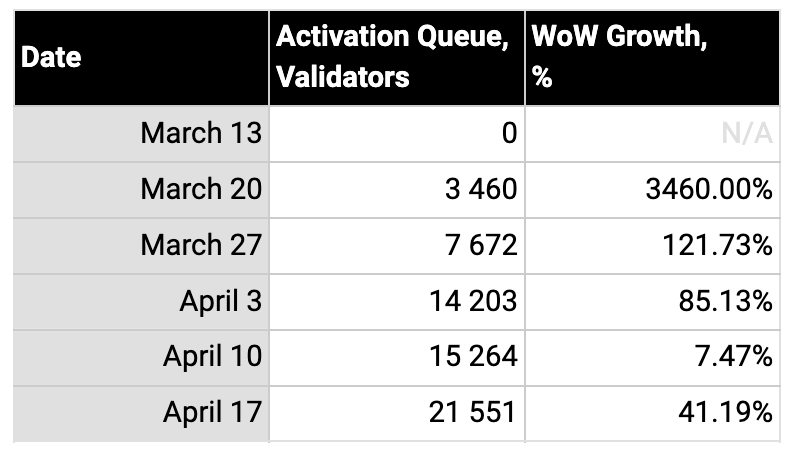
In essence, EIP-7514 serves as a temporary measure to regulate validator growth until a more permanent solution is established. So here’s what we have one month after Dencun:
- Currently, the activation queue has decreased to 16k validators or 9 days for the last one to become an active validator
- On April 14, Ethereum crossed the 983k active validators mark, which increased the exit churn limit to 15 validators per epoch
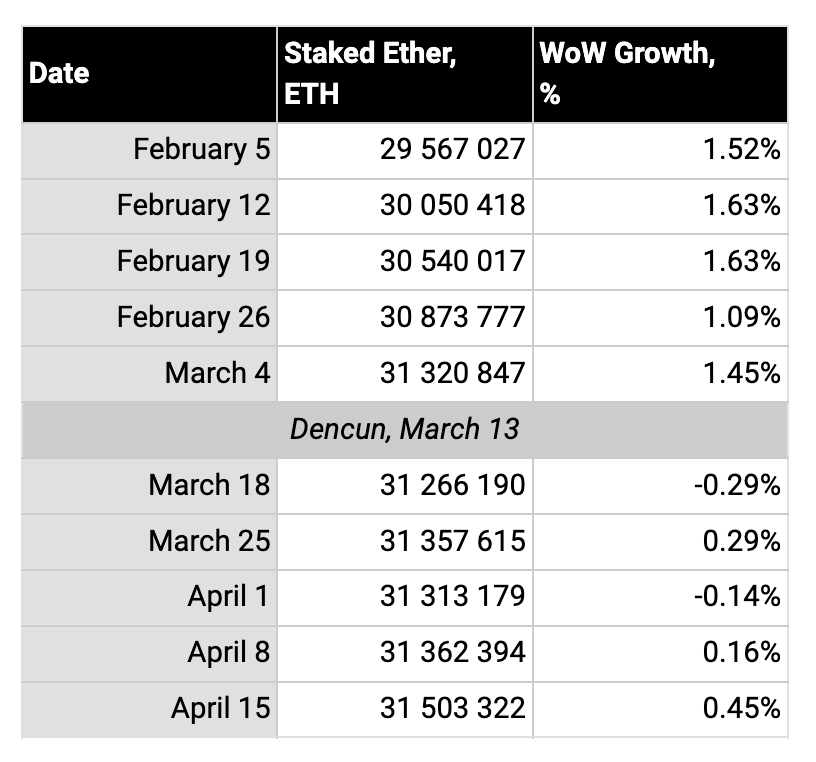
Most notably, Dencun has effectively slowed down the pace of ETH stake growth from about 1.5% a week to a mere 0.09%, as the table below shows.
Wrap-Up
The Dencun upgrade for Ethereum is showing early signs of success. The jury's still out on the overall effect, but things are looking good so far. The network runs smoothly, handling more activity with higher efficiency and better cost-effectiveness for rollups.
Follow Everstake to stay updated on all that is happening in Ethereum after the Dencun upgrade. Everstake is a responsible validator trusted by 735K+ users across 70+ blockchain networks.
Everstake’s mission is to make financial empowerment through staking accessible to everyone. With profound expertise and unwavering dedication to decentralization, we pave the way for our users to cultivate lasting financial growth and empower them to make informed staking decisions through our extensive knowledge base.

More from Research



Institutional-Grade Research
Delivered to Your Inbox
Join 12,000 institutional allocators worldwide. No spam, unsubscribe anytime.