5 ways to stake your crypto assets

TL;DR;
- Staking is the backbone that helps secure all proof-of-stake (PoS) blockchains.
- Each type of staking has its own associated benefits and risks, always DYOR.
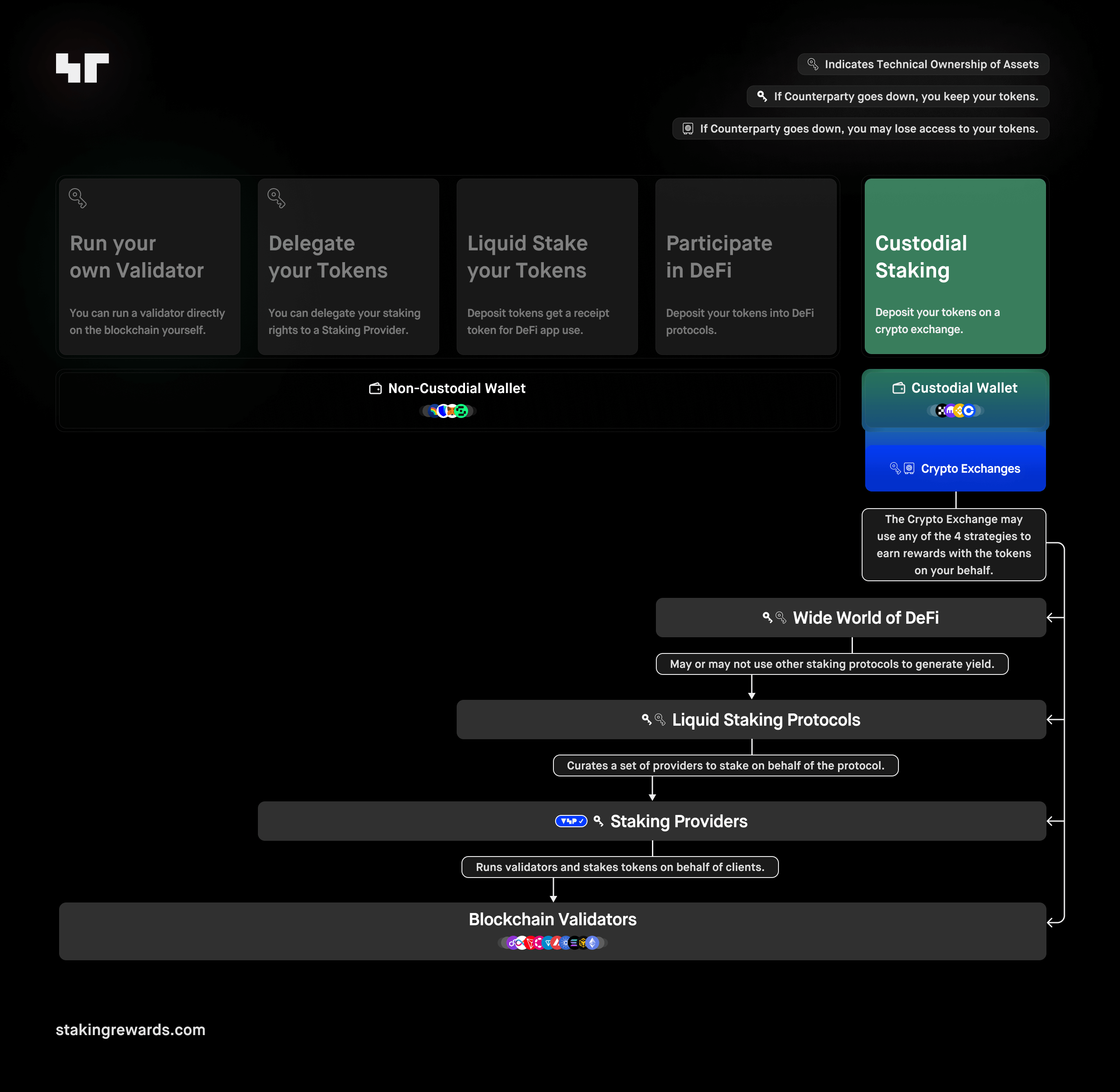
- Options to stake include running your own validator, delegation, liquid staking, DeFi staking and custodial staking.
- There is no right or wrong way to stake, you should choose a method based on your own preferences and risk appetite.
Staking is the lifeblood of the crypto industry. It’s an essential component to ensure the stability and security in all proof-of-stake (PoS) blockchains.
Validators in a PoS blockchain are entities that ensure the stability and security of the network. Validators in the network take part in consensus by staking their own tokens, in exchange for doing so, they qualify for rewards. Collectively, validators verify transactions and propose and attest the creation of new blocks.
Staking refers to the process of locking your tokens to a validator to actively contribute to consensus on the network.
Before staking your assets, it’s worth asking yourself why you want to participate in staking in the first place. The answer to this question can influence your decision on how you stake your assets.
Staking can be done in 5 different ways, each with its own level of underlying risk, reward and complexity.
To conceptualize this in terms of risk, staking can be compared to the traditional financial world in the sense that holding a bank note has a different level of risk and complexity to holding a government bond, or investing in the stock market.
Run your own Validator (Solo Staking)
Running your own validator node, also known as solo staking, is the most direct way to stake your assets. By doing so, you interact with a blockchain directly to participate in network consensus. This option gives you full control over the staking process with few or no intermediaries.
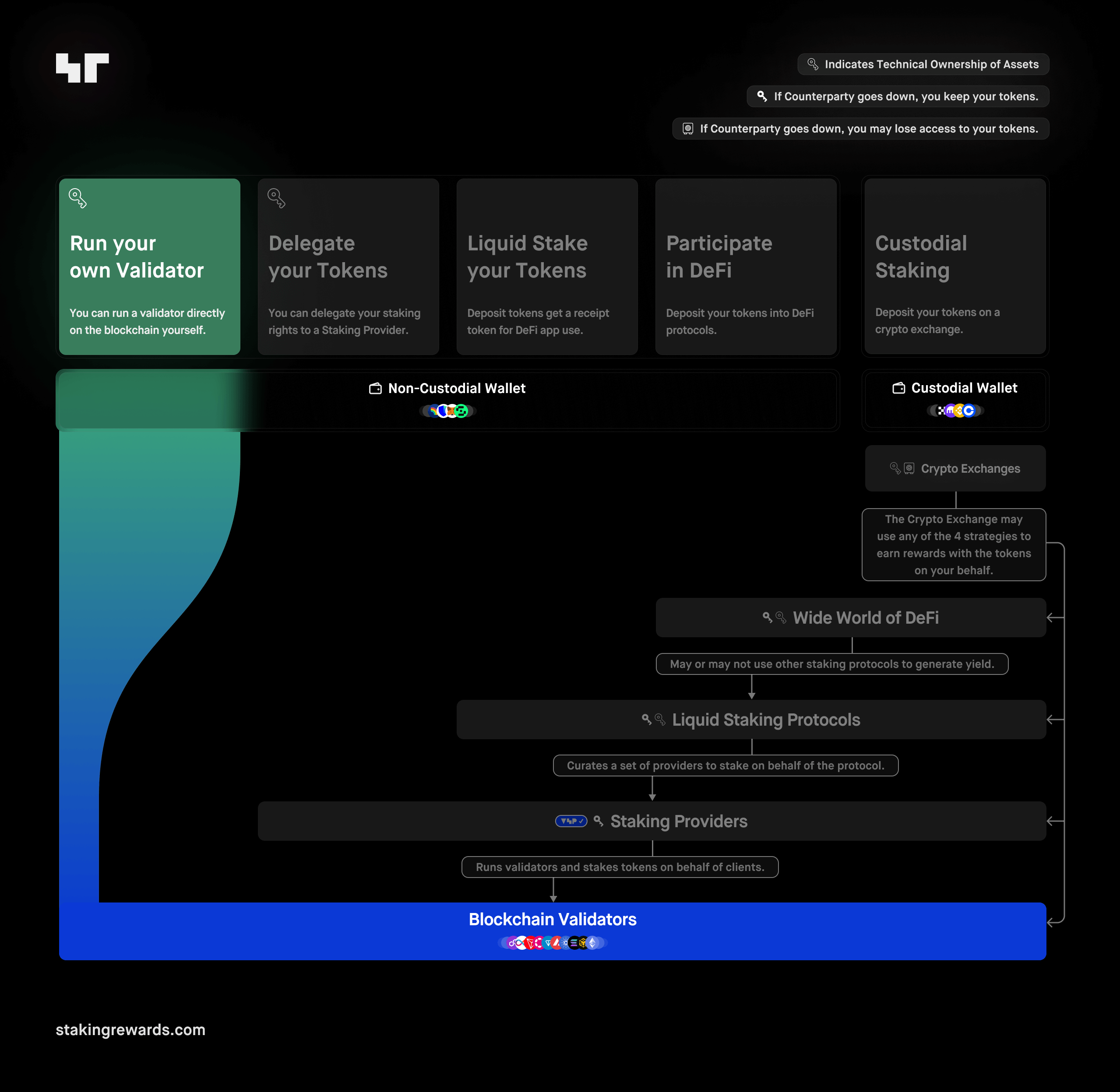
What are the benefits of running your own validator?
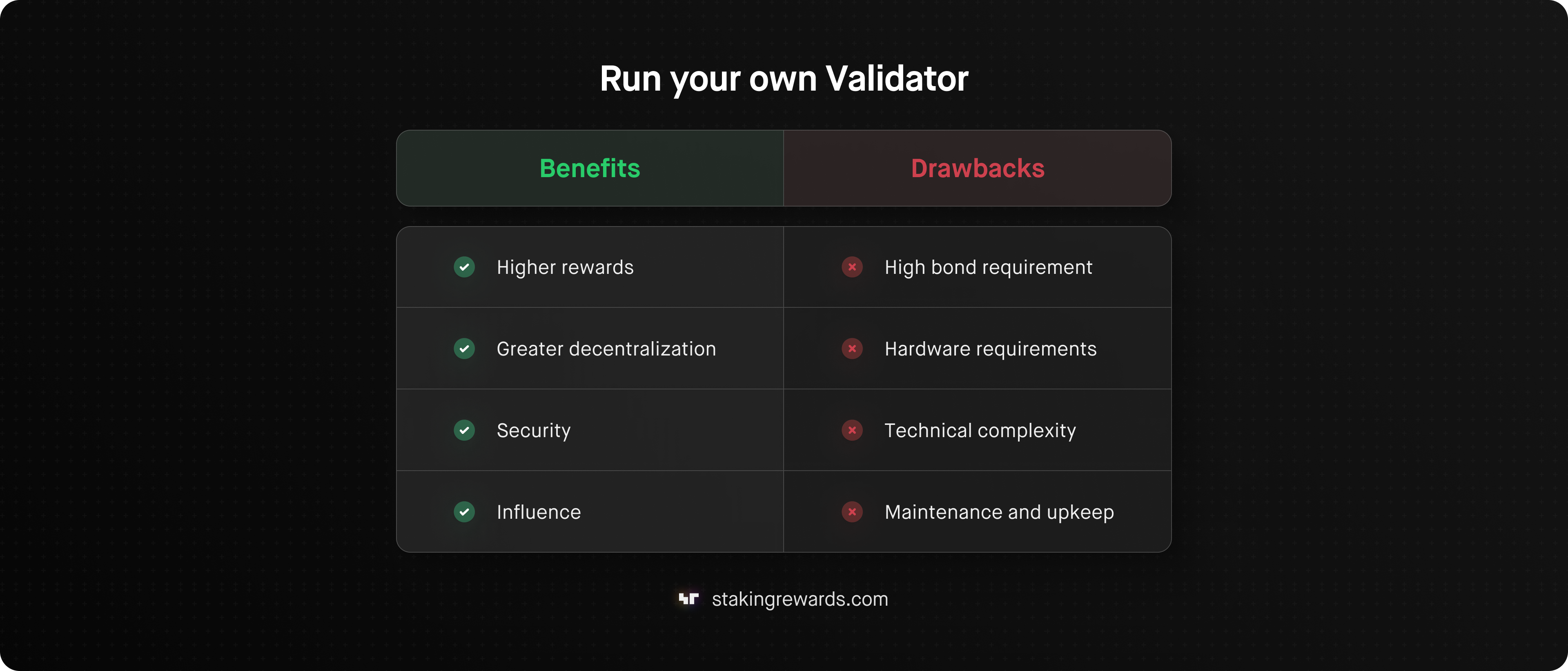
The benefits of running your own validator include:
Higher rewards: Users that run their own validators typically get a higher staking reward rate. This is because the staker gets 100% of the rewards from the Ethereum protocol, without any middleman taking a cut by applying fees.
Decentralization: Seen as the gold standard in staking, running your own validator is the best way to contribute to the decentralization of a network. The more independent validators there are, the more resilient the network becomes against centralization and single points of failure.
Security: When you run your own validator node, you have complete control over its security measures. You can ensure that your node is properly configured and updated to the latest security standards, reducing the risk of attacks and unauthorized access.
Influence: Many proof-of-stake blockchains make decisions on the future of the protocol via a form of on-chain governance.
What are the main challenges of running your own validator?
Running a validator is not for everyone. It typically has a high barrier to entry, the most common drawbacks include:
High bond requirement: The bond requirement also needs to be considered if planning to run your own validator. For Ethereum, you must put up 32 ETH, which already limits the amount of users able to take part in this form of network consensus.
Hardware requirements: Each different proof-of-stake blockchain has its own minimum hardware requirements in order to run the software needed to stake.
Technical complexity: Once the right set up is acquired, you need to be able to configure it correctly, generate and store your own private keys
Maintenance and Upkeep: Performing maintenance is another essential part to ensuring your node is secure, runs smoothly and avoids being slashed. This involves running regular software updates and security patches to keep your validator running efficiently. Monitoring tools and alert systems are also essential in helping to identify potential issues and maintaining the upkeep of your validator.
Regulatory Compliance: Depending on the jurisdiction, running a validator may involve regulatory considerations, such as compliance with financial regulations or data protection laws.
Staking-as-a-Service providers
If you don’t want to run your own validator, another option is to let a professional staking provider stake on your behalf.
This method of staking requires handing over your validator credentials and signing keys to the provider. To limit counterparty risk, the keys to withdraw your ETH are usually kept in your possession.
In the case of Etheruem, this would still require depositing 32 ETH which is the minimum amount needed to run a validator.
Delegate Your Own Tokens
Outside of Ethereum, you also have the option to delegate your tokens to a public validator.
This staking option enables you to earn a percentage of block rewards, by staking passively to a validator run by an established third party.
Delegate your tokens with confidence by choosing a trustworthy staking provider from our list of Verified Staking Providers.
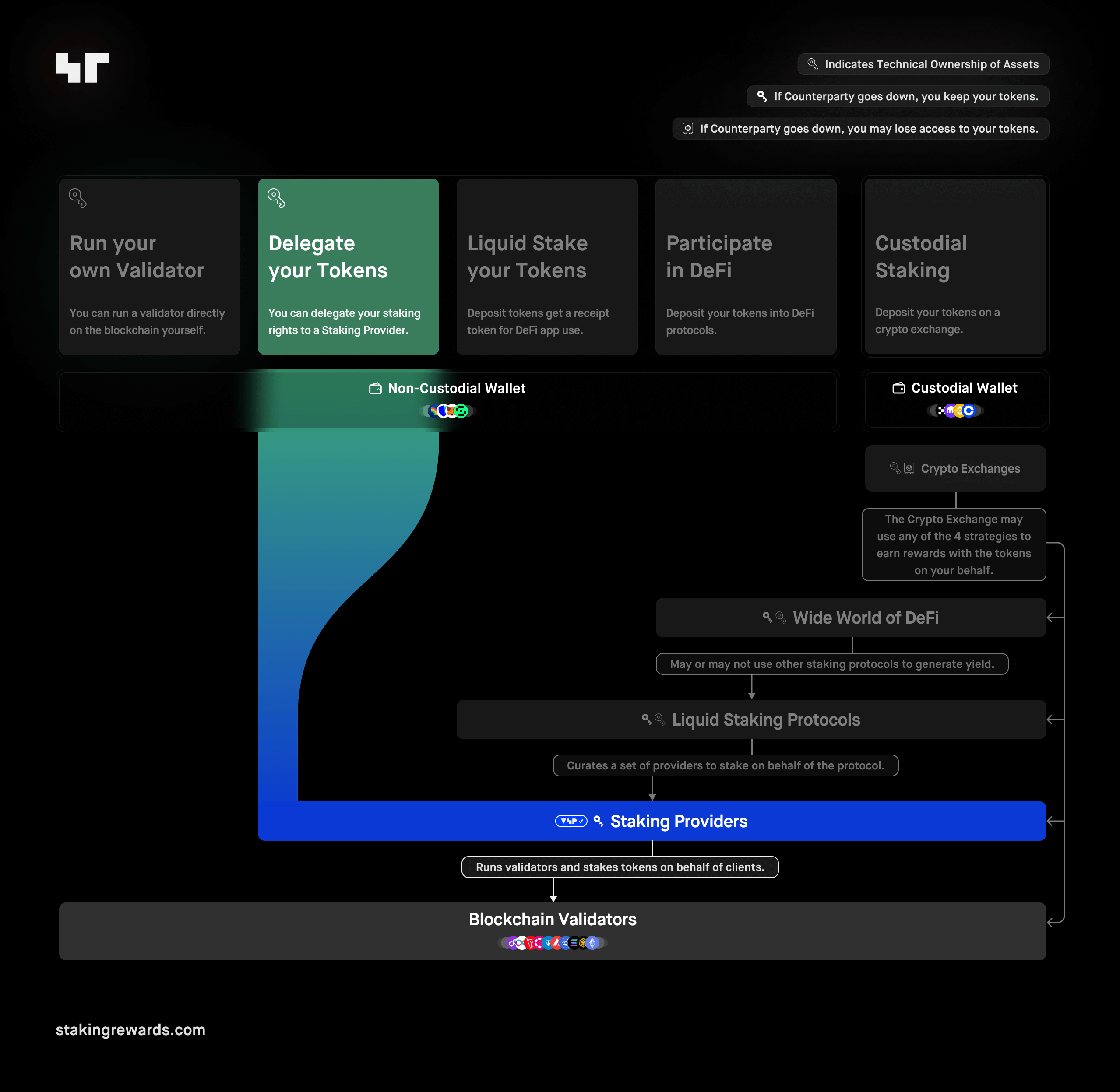
What are the benefits of delegating your tokens?
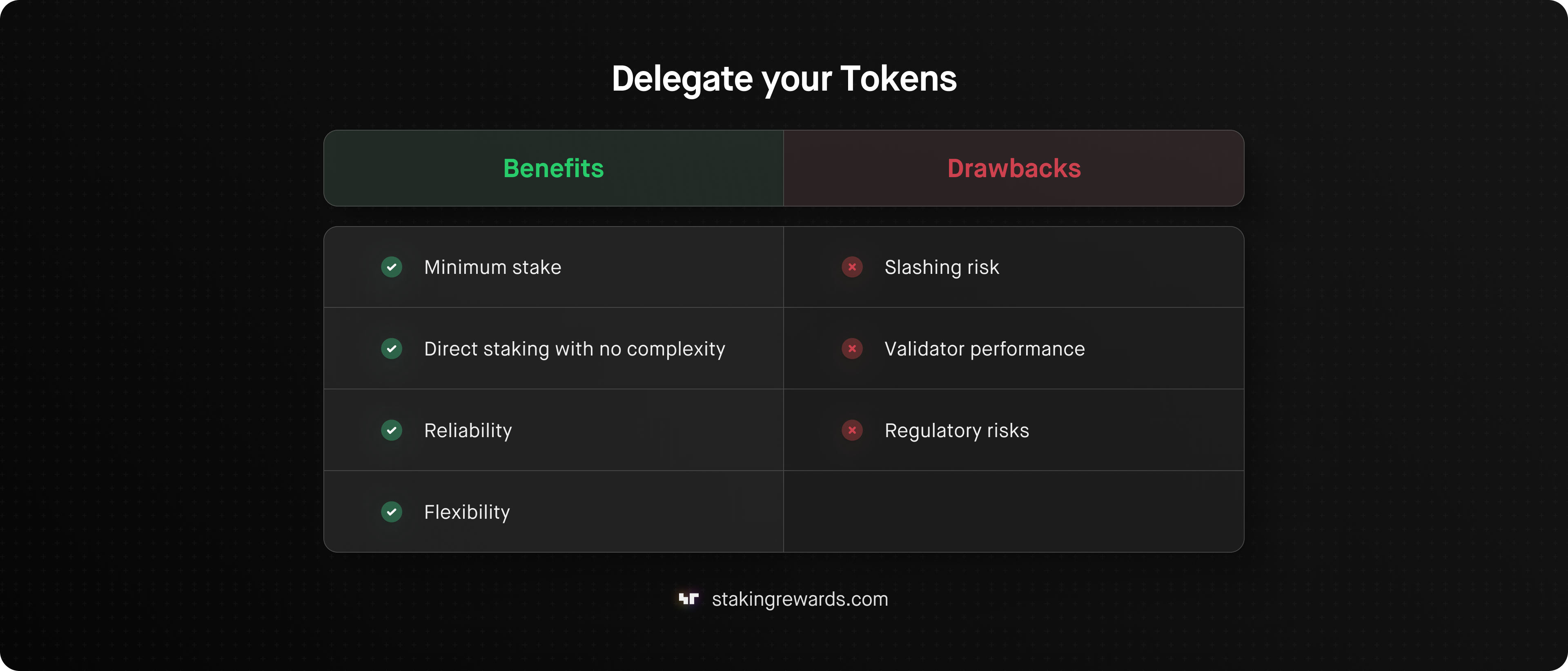
Minimum stake: Depending on the network, there is a minimum amount of tokens required to take part in delegation. This amount is typically low, or in some cases 0, which lowers the barrier to entry for staking directly with a validator.
Direct staking with no complexity: Delegation is the most direct way you can stake your tokens, without needing any technical expertise. All of the heavy lifting is covered by the staking provider that is running the public validator you stake on.
Reliability: A clear benefit of delegation, is that the staking service provider that you choose often has extensive experience in optimizing staking performance, maximizing rewards, and mitigating risks associated with validator operation.
Flexibility: Through delegation, you have the flexibility to unbond, or remove your tokens at any time. This is subject to each individual protocol’s unbonding period, which varies from network to network - for instance, Tezos or Cardano have no unbonding period.
What are the risks associated with delegating your tokens?
It is essential to conduct thorough research before delegating your tokens to any validator. When delegating you are trusting that the validator will behave correctly and help secure the network on your behalf. Factors to consider include their security setup, reliability and business operations.
To mitigate any risk, you can choose to delegate with one of our Verified Staking Provider (VSP), all of which have had their security setup, reliability, and business operations scrutinized by the Staking Rewards team.
Risks of delegating your tokens include:
Slashing risk: In many PoS networks, validators are required to put up a stake as collateral to ensure their honest behavior. If a validator behaves maliciously or fails to perform its duties correctly, a portion of their stake may be slashed, and the delegators may also suffer losses. This can happen due to actions such as double signing, offline or unavailable nodes, or other protocol violations.
Validator Performance: Validators may have varying levels of reliability and uptime. If you delegate your tokens to a poorly performing validator, you may miss out on rewards or suffer penalties. It's crucial to research validators thoroughly and choose those with a proven track record of reliability and security.
Regulatory Risks: Depending on your jurisdiction, there may be regulatory risks associated with staking or delegating tokens. Regulatory changes could affect the legality or tax treatment of your staking activities. Stay informed about regulatory developments in your area and consult with legal experts if needed.
Liquid Stake Your Tokens
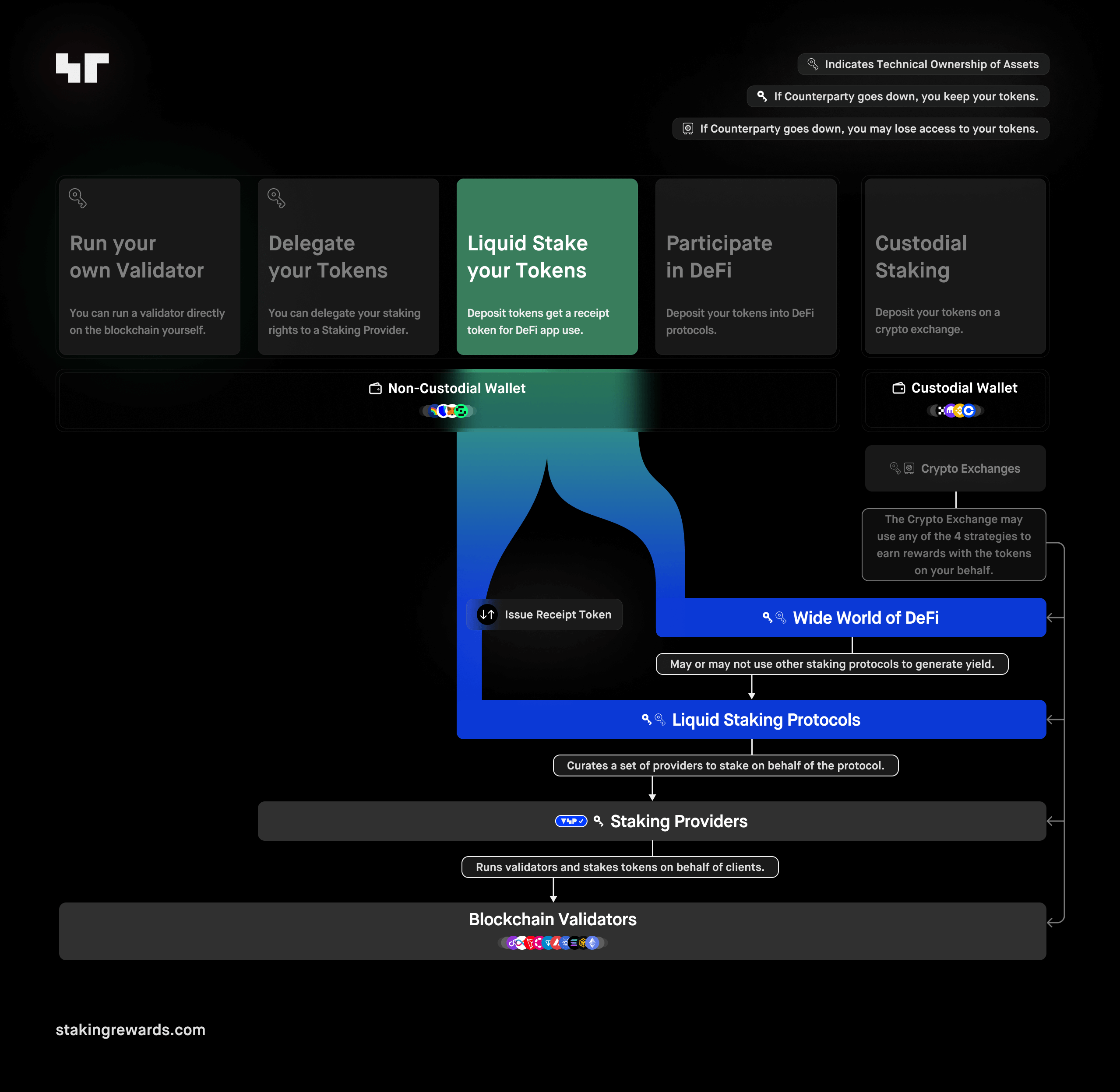
Liquid staking is the process of depositing your tokens to a liquid staking protocol. In exchange, you receive liquid staking tokens (LSTs), which are receipt tokens that represent your staked amount.
What are the benefits of liquid staking?
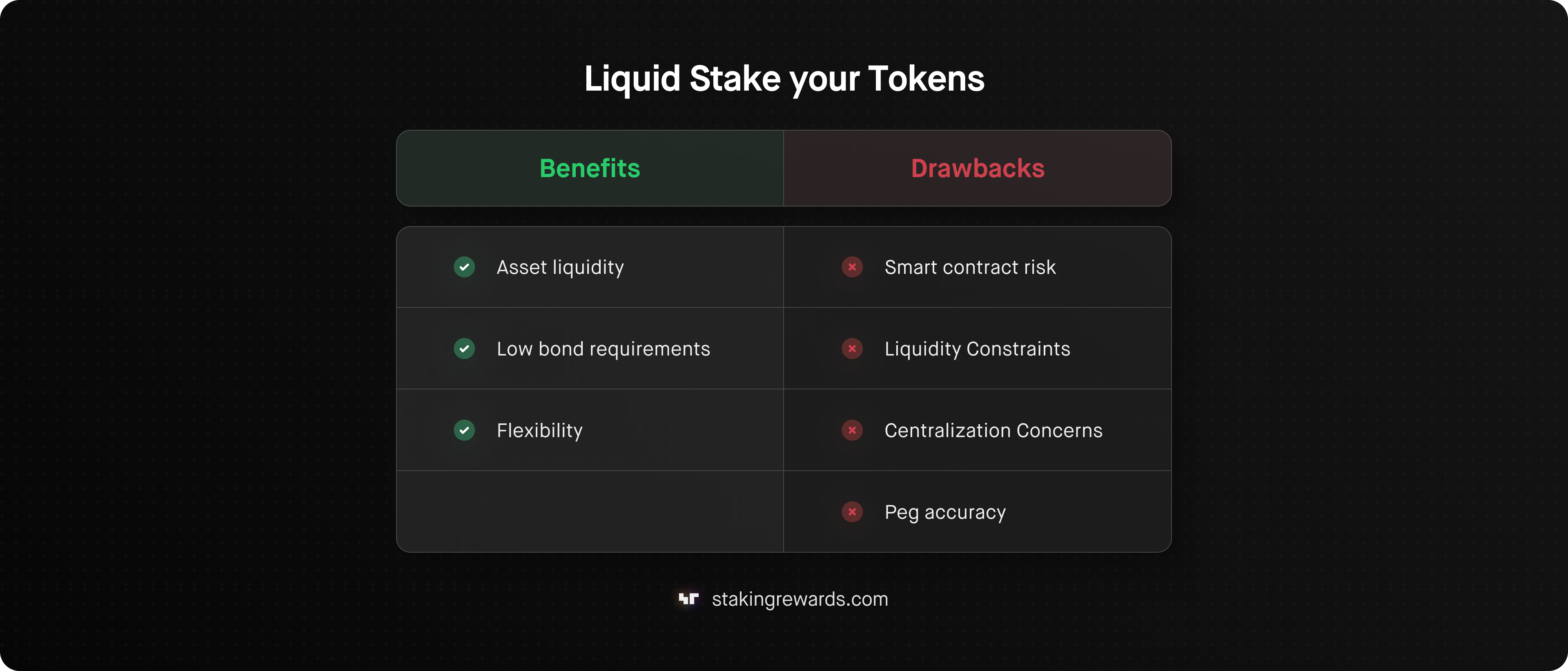
Asset liquidity: Perhaps the most obvious benefit of liquid staking is the ability to unlock liquidity from your staked assets. By liquid staking, you can trade, lend, or use your LSTs in various decentralized finance (DeFi) protocols whilst still earning the staking rewards on your asset.
Low bond requirements: Liquid staking lowers the requirements needed to stake by reducing the minimum amount of tokens required to take part in the staking process.
Flexibility: Liquid staking allows you to easily enter and exit your staked position at any time. You can stake or unstake by swapping your tokens via a decentralized exchange, otherwise you can stake or unstake via the Liquid Staking Protocol directly (unstaking may include a waiting period). This flexibility empowers you to respond to market dynamics and fine-tune your investment strategy accordingly.
Potential drawbacks to liquid staking
Whilst liquid staking is a popular option for many, there are still risks that need to be considered, these include:
Smart Contract Risk: To liquid s as these liquid tokens could be vulnerable to hacks or smart contract vulnerabilities.
Liquidity Constraints: While liquid staking aims to enhance liquidity for staked assets, there may still be constraints on liquidity compared to traditional liquid assets. This could limit the ability of users to quickly access their staked funds when needed.
Centralization Concerns: Liquid staking protocols often require centralized custodians or validators to manage the staked assets. This reliance on centralized entities could undermine the decentralization ethos of blockchain networks.
Peg accuracy: LSTs are receipt tokens that represent the underlying staked asset. The value of your LST should maintain its peg against the underlying asset, if it doesn’t your LST may lose its original value.
Participate in DeFi
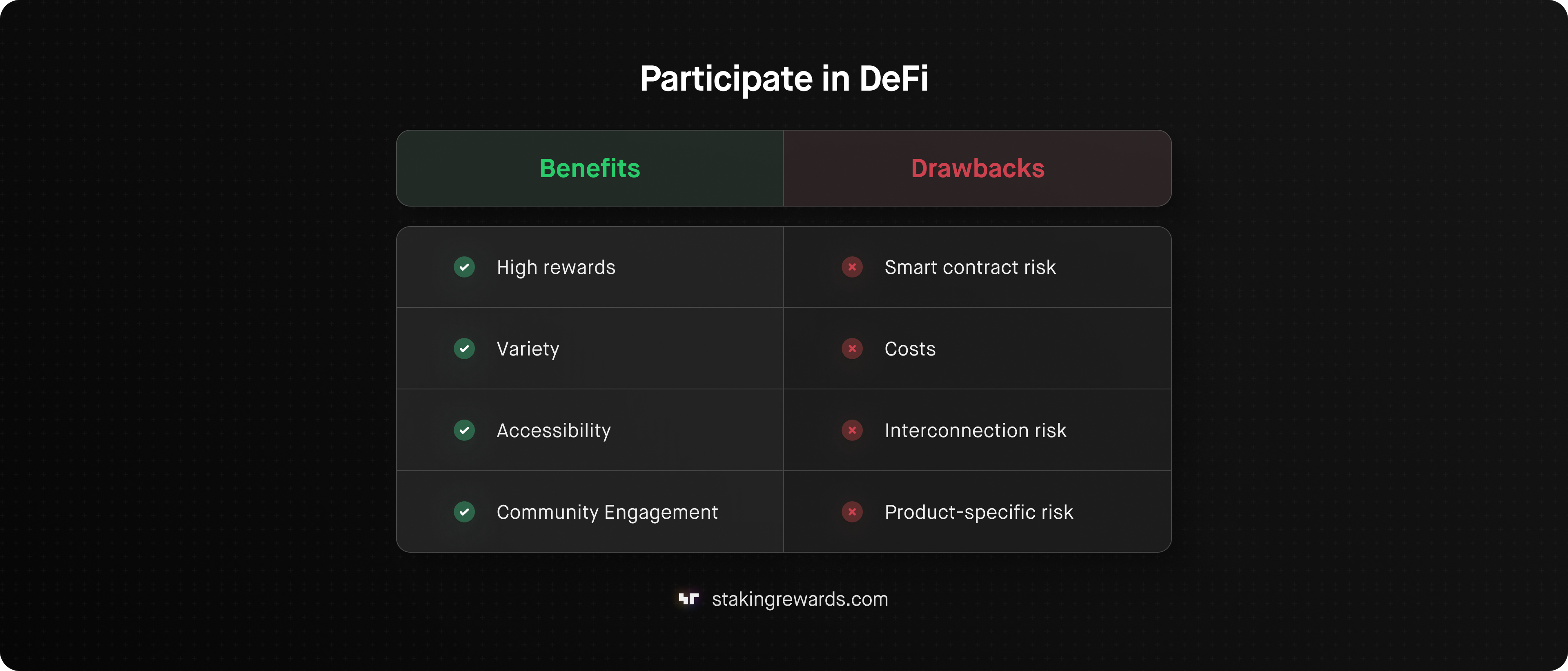
In most cases, staking refers to locking your tokens to actively participate in the security of a proof-of-stake network.
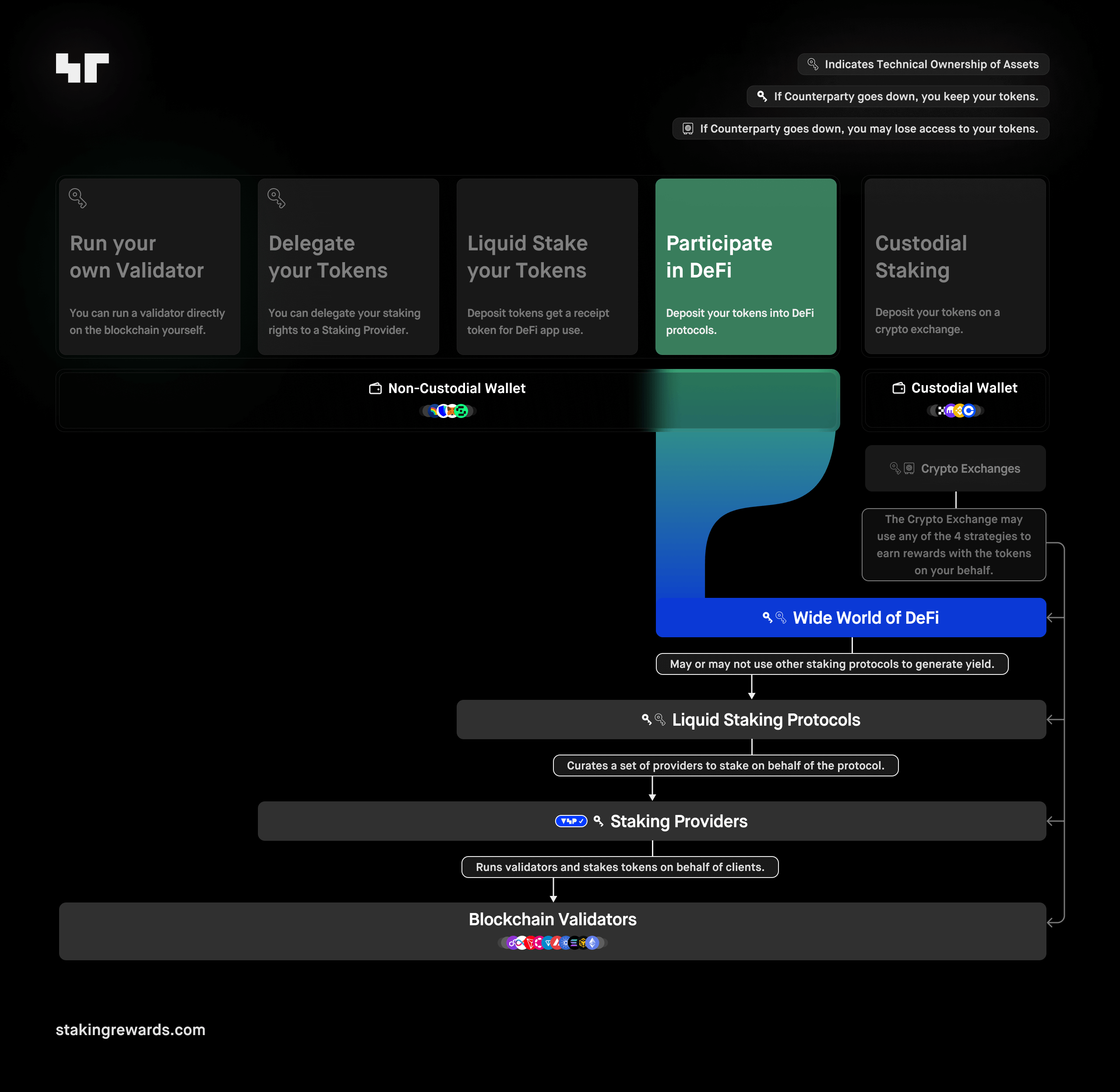
Staking in most DeFi protocols is an option that allows token holders to participate in liquidity pool provision, governance or earn a share of the protocol’s fees by using their tokens. Staking methods are highly diversified; they can involve solely staking the protocol’s native asset or combining it with other tokens to provide liquidity.
Each protocol uniquely defines its staking mechanisms, which may include a variety of roles as specified by their smart contracts.
Custodial Staking
Custodial staking is where you delegate your tokens to a third-party custodian to handle the staking process on your behalf. This service is usually offered by centralized exchanges (CEXs) or web3 wallet providers.
What are the benefits of custodial staking?
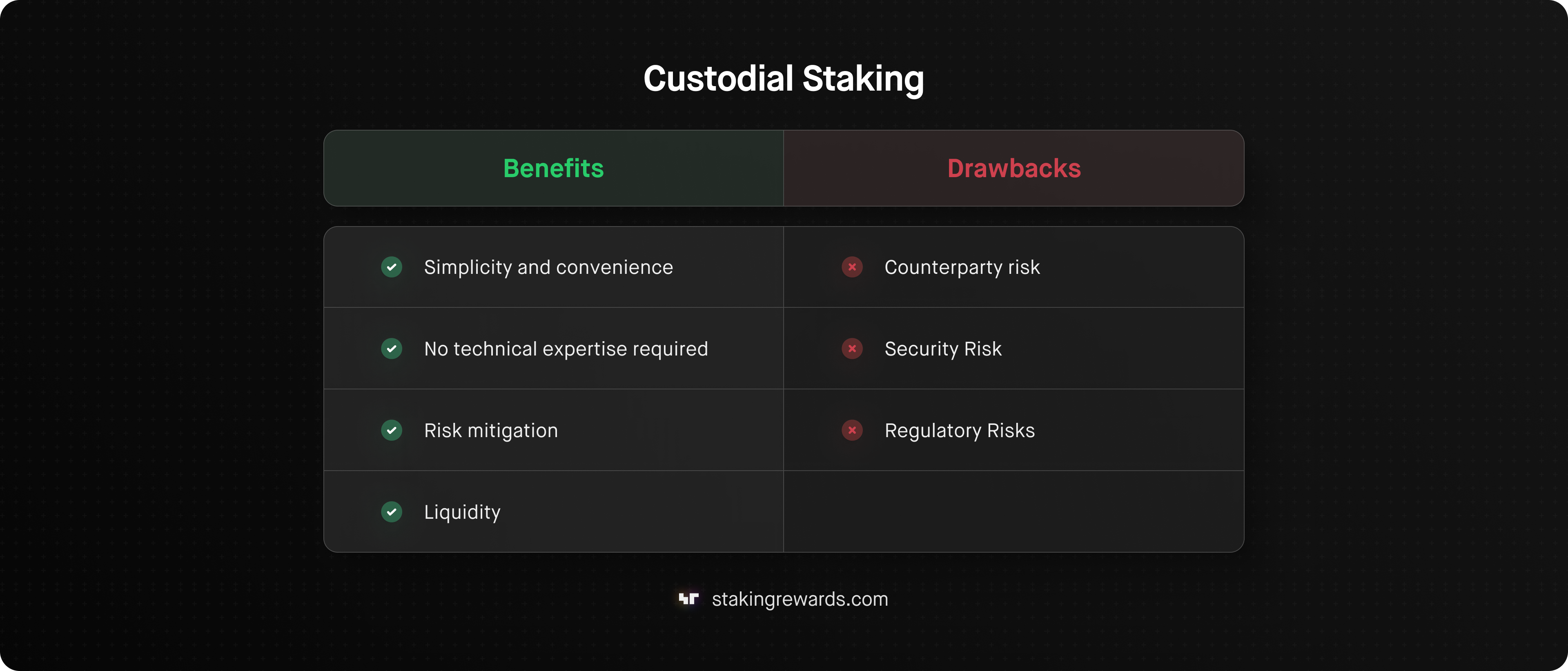
Simplicity and Convenience: Custodial staking platforms typically offer a user-friendly interface that simplifies the staking process. This means that you can usually stake your tokens in just a few clicks.
No Technical Expertise Required: By staking with a custodial provider, you don’t need any technical knowledge or experience in running validator nodes. This lowers the barrier to entry, allowing a broader range of investors to participate in staking and earn rewards.
Risk Mitigation: Custodial staking platforms often implement risk management measures to protect your staked assets. This may include insurance coverage, secure storage solutions, and proactive monitoring for potential security threats.
Liquidity: Custodial staking often allows users to retain the liquidity of their tokens. Users can freely transfer or trade their tokens at any time, even while they are being staked.
What are the main drawbacks of custodial staking?
Counterparty risk: Custodial staking requires you to hand over control of your assets to a third party. This means that the custodian is responsible for managing your staked assets. Potential risks can include fund mismanagement or even insolvency, which could result in the loss of your funds.
Security risk: Centralized exchanges are prime targets for hackers due to the large amount of funds they hold. If the exchange's security measures are compromised, your staked assets could be at risk of theft.
Regulatory Risks: Depending on the jurisdiction, staking on a CEX may come with regulatory implications. Changes in regulations could affect the legality or operation of staking services on the exchange, potentially impacting your staked assets.
Overall, custodial staking offers a convenient and accessible way for users to participate in staking and earn rewards without the technical complexities and operational overheads associated with other ways to stake. However, users should carefully evaluate the reputation and security measures of custodial staking providers before delegating their assets.
Which staking option works for you?
In conclusion, staking serves as the bedrock of the crypto industry, maintaining the integrity, security, and decentralization of proof-of-stake blockchains.
It's important to not that there is no wrong or right way to stake. Whether through running your own validator, delegating tokens, liquid staking, or opting for custodial services, there are various avenues for individuals to engage in staking based on their preferences and risk appetite.

More from Infographics
Institutional-Grade Research
Delivered to Your Inbox
Join 12,000 institutional allocators worldwide. No spam, unsubscribe anytime.