Mapping the Institutional Digital Asset Yield Ecosystem

TL;DR;
- First end-to-end map of how institutional capital flows into onchain yield.
- TradFi and crypto-native allocators are converging — same opportunity, same infrastructure.
- Seven yield verticals signal a market well beyond simple staking.
Institutional capital is moving onchain. The question is no longer whether — it's how.
With the Institutional Digital Asset Yield Ecosystem Map we are mapping the full stack: from allocators deploying capital, through the middleware enabling access, to the protocols generating yield.
Allocators & Institutions
The map tracks capital across five hubs — New York, Miami, Abu Dhabi, Zurich, and Singapore. Aligned with our 2026 locations for the Digital Asset Yield Summit. Other noteworthy hubs are London, Paris, and Frankfurt. Apollo, Millennium, Two Sigma, and KKR now target the same opportunity set as Pantera and Multicoin. Below them, institutions like Fidelity, Goldman Sachs, UBS, and Standard Chartered are building the on-ramps.
Middleware & Infrastructure
Between capital and yield sits the layer that makes institutional participation possible. Without it, yield protocols remain inaccessible to regulated capital. The map identifies seven categories, each solving a distinct problem in the institutional stack.
Custody & Key Management is the entry point. Fireblocks, Anchorage Digital, BitGo, Copper Co, and Zodia handle the secure storage and movement of institutional assets — the non-negotiable prerequisite before any capital can be deployed onchain.
Prime Brokerage & Execution provides the trading infrastructure. FalconX, Coinbase, Hidden Road, and LMAX Digital give institutions the execution quality, credit, and counterparty relationships they require before committing meaningful size.
Market Makers & Liquidity — Keyrock, Wintermute, B2C2, GSR, Optiver, and CMT Digital — ensure that when institutions trade, there is depth on the other side. Institutional capital does not deploy into thin markets.
Tokenization & Issuance is where traditional assets become onchain instruments. Securitize, Paxos, Chainlink, Tokeny, and Zoniqx are building the legal and technical rails that turn a Treasury bill, a private credit fund, or a real estate vehicle into a programmable onchain asset.
Risk & Vault Curation — Gauntlet, Steakhouse, Sentora, and Bitwise — provides the independent risk assessment layer. As yield strategies grow more complex, institutions need structured oversight of the protocols they're allocating to.
Staking Infrastructure — Figment, P2P.org, The Tie, and Nansen — supports the growing demand for onchain yield through validated, institutional-grade staking operations and the data infrastructure that sits around them.
Crypto-Native Banks — Amina Bank, Sygnum, Xapo, Bank Frick, Matrixport, and Bergos AG — complete the stack, providing the regulated banking relationships that connect onchain activity back to the traditional financial system.
Yield Protocols
The yield layer has moved well beyond simple staking. Seven verticals now represent a structured, composable yield market serving institutional appetites across risk profiles and asset classes.
RWA & Tokenized Yield — Backed Finance, Centrifuge, Ethena, Ondo, Securitize, Sky, Trade.xyz, and DreamCash — brings real-world yield onchain. T-bills, private credit, and tokenized fund structures are now accessible as programmable assets within DeFi.
Staking — Liquid Collective, Lido, Ether.fi, Jito, Marinade, Lombard, Babylon, and Solv — provides the foundation. Institutional-grade liquid staking has matured significantly, with validators and protocols now built specifically for regulated participants who require compliance, reporting, and custody integration.
Vaults — Cap, Rysk Finance, Sentora, Steakhouse, Yearn Finance, Yield Basis, Veda, Byzantine, Mellow, and Looping Collective — represent the structured product layer of DeFi. Vaults aggregate and automate yield strategies, giving institutions access to optimised returns without requiring active management of individual positions.
Onchain Credit — Aave, Compound, Flying Tulip, Morpho, Spark, Kamino, and Curve — is the lending backbone. These protocols enable capital to be put to work against onchain collateral, with Morpho and Aave in particular now operating institutional-grade vaults with defined risk parameters.
Fixed Income — Notional Finance, Pendle, Pye Finance, Term Finance, Treehouse, and Gyld Finance — brings duration and rate exposure onchain. Pendle in particular has created a functioning market for yield stripping, allowing institutions to separate and trade the fixed and variable components of onchain yield instruments.
Private Credit — Clearpool, Goldfinch, Maple, Valos, Open Eden, USD AI, Mountain Protocol, and TrueFi — extends institutional lending into the onchain world. These protocols are bridging the gap between traditional private credit markets and DeFi liquidity, with Maple and Clearpool now managing nine-figure loan books.
BTCFi — Mezo, Rootstock, Stacks, and Starknet — is the emerging frontier. As Bitcoin holders seek yield without leaving the Bitcoin ecosystem, this vertical is building the infrastructure to put the world's largest crypto asset base to work in a structured, credible way.
Networks
Four settlement layers have emerged as the reliable anchors of the institutional onchain ecosystem.
Ethereum is the foundation — half of all DeFi TVL, the majority of stablecoin settlement, and the chain where the most consequential institutional experiments are running. BlackRock's BUIDL fund, Apollo's tokenized private credit, and Rain's onchain lending infrastructure are all built here.
Solana is the momentum story. J.P. Morgan and Citi have both executed live debt instruments on the network. Visa is settling stablecoin transactions for U.S. banks at a $3.5 billion run rate. State Street has announced a tokenized liquidity fund. Solana RWA value recently hit an all-time high of $1.5 billion.
Hyperliquid owns onchain perpetuals. It has taken dominant market share from centralized venues and is now the premier venue for 24/7 price discovery on commodities — oil, silver, metals, indices. When US-Iran tensions moved markets last month, multiple days topped $6 billion in volume, with silver alone exceeding $1 billion in 24 hours.
Canton operates differently. A permissioned network purpose-built for regulated capital, its metrics are institutional rather than public. Goldman Sachs, BNP Paribas, and others running live nodes is the data point that matters.
Together they represent complete coverage: two open networks competing on activity and adoption, one built for derivatives and real-world price discovery, and one purpose-built for regulated capital.
From Mapping to Rating
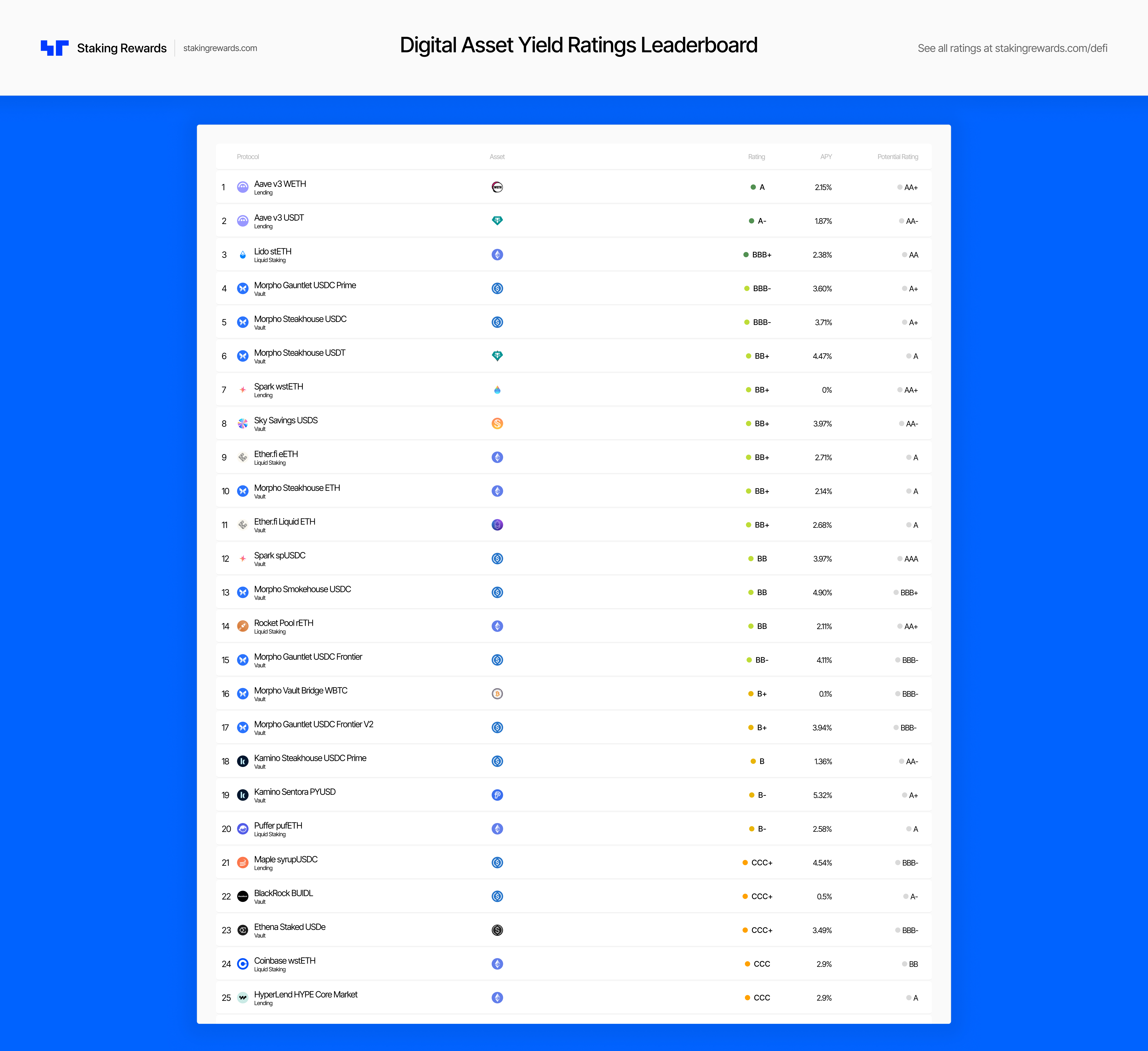
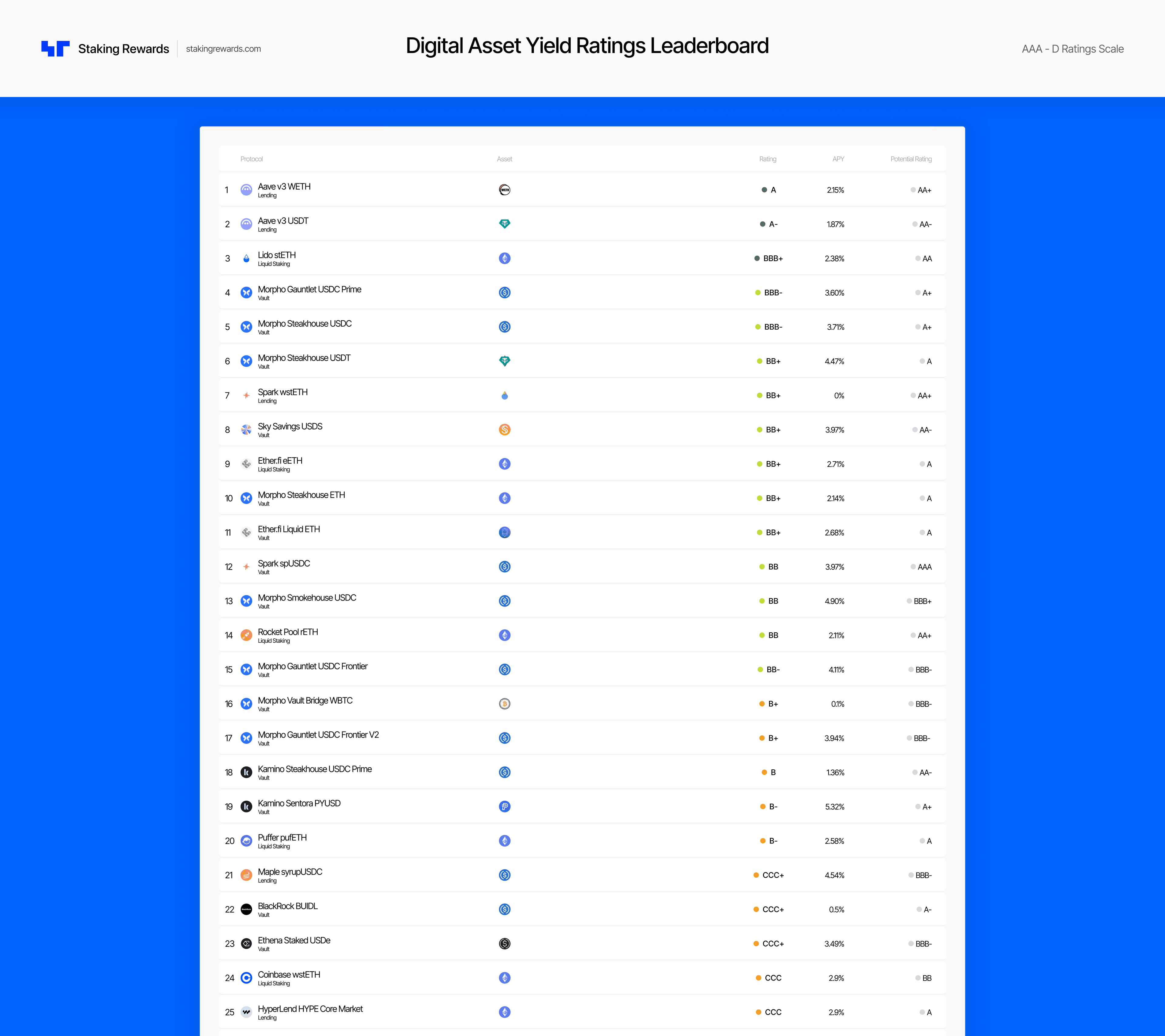
Mapping the ecosystem is step one. Rating it is step two. Alongside this map, we've published the first 25 independent DeFi yield ratings — structured, credit-rating-style risk assessments for onchain yield protocols, built entirely on public information. Explore the full leaderboard at stakingrewards.com/defi.
About Staking Rewards
Staking Rewards is the independent rating and data platform for digital asset yield. Trusted by institutions including Fidelity and Coinbase, we rate and track 90+ verified yield providers across 120+ digital assets. Through our ratings, research, data API, and the Digital Asset Yield Summit (DAYS), we help allocators navigate onchain yield with clarity and confidence. Learn more at stakingrewards.com.

More from Featured

Institutional-Grade Research
Delivered to Your Inbox
Join 12,000 institutional allocators worldwide. No spam, unsubscribe anytime.